Images 2.6, Linux vulnerability research and health AI evaluation
Issue date:
This issue covers new tools for visual content, a research prototype for finding vulnerabilities, and an approach to evaluating AI responses to health questions.
This issue may include important events published earlier.
Images 2.6 is available globally in ChatGPT and Codex across all subscription tiers, as well as through the API. The update adds GIF creation and new image-editing options.
Key facts
OpenAI says Images 2.6 generates images 50% faster than before. In the API, Flare can produce an image in as little as six seconds with the quality setting on low.
The API offers Flare and Sunburst, markup to specify areas for edits, SVG export, and a complexity parameter that controls how much planning the model does. Image quality is set separately.
An objective look at what matters
Marketing and product teams could try visual variations more quickly and add animation to campaigns.
Business processes
Creating marketing and product assets — Rapid image and GIF variations could speed up draft production.
Automation opportunities
Creating and editing visuals through the API: Teams could incorporate generation, edit markup and export into asset production. Conditions: The choice of Flare or Sunburst, quality and complexity depends on the task; API use is priced.; Content and brand consistency need review before publication.
Impact on manual work
The model could handle some draft creation and editing, but labor savings in a specific workflow have not been established.
Limitations and risks
Speed depends on the model variant and settings; the performance figures are OpenAI's claims.
Outputs and exported files should be checked before use.
OpenAI tests agent-based Linux kernel vulnerability research
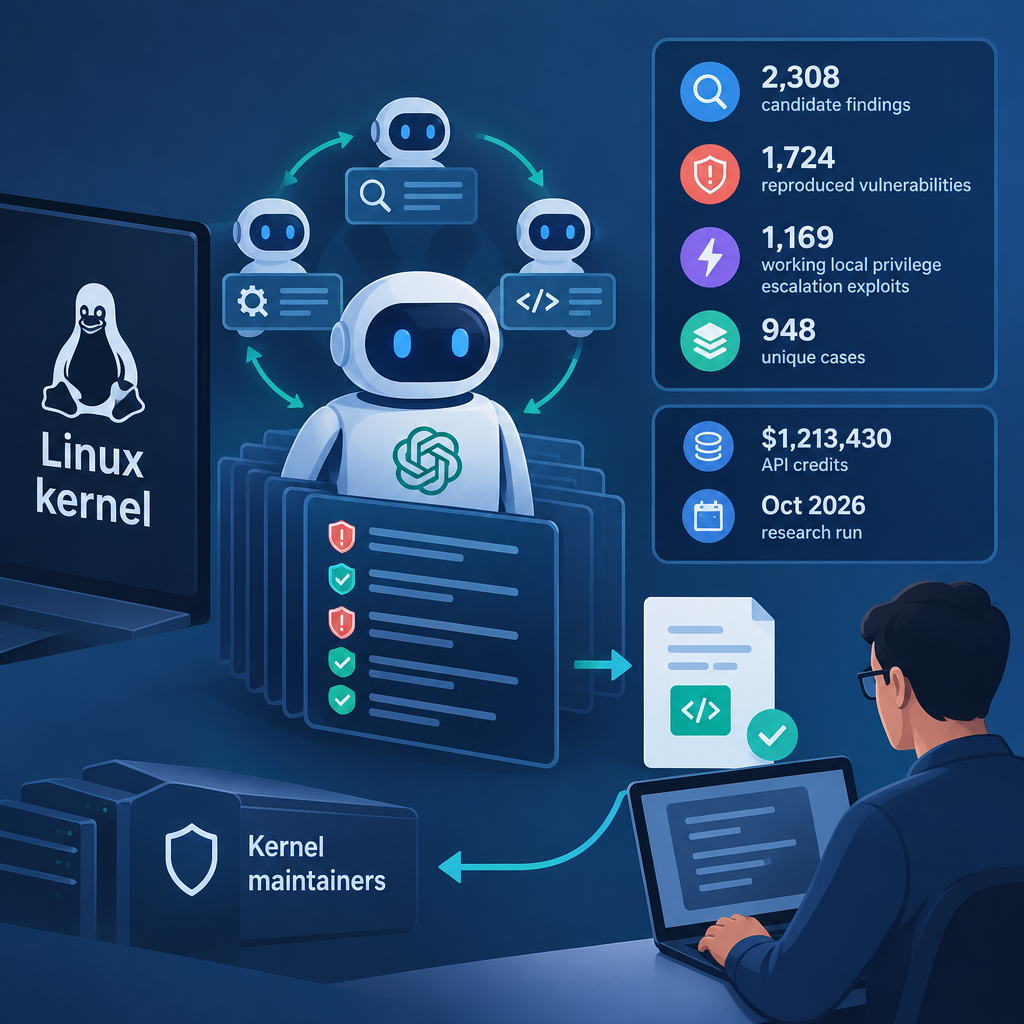
OpenAI published results from a prototype tested in a controlled environment. It uses AI agents—programs that carry out multistep tasks—to find and validate vulnerabilities and draft patches. Security researchers then review the outputs.
Key facts
OpenAI says the system analyzed 2,308 candidate findings and reproduced 1,724 vulnerabilities. It also produced 1,169 working local privilege escalation exploits. The company counts 948 unique cases based on the number of distinct patches for the underlying vulnerabilities.
OpenAI reports that the mid-October 2026 research run using an upcoming cyber model cost $1,213,430 in API credits. The company has begun sending kernel maintainers reports and proposed patches for critical vulnerabilities.
An objective look at what matters
The research suggests a way to handle a large volume of findings, while highlighting validation costs and the workload for researchers and maintainers.
Business processes
Security auditing and patch preparation — Reproducing vulnerabilities and assessing exploitability could help teams prioritize findings.
Automation opportunities
Finding, validating and preparing fixes for vulnerabilities: Agents could produce evidence and draft patches for human review. Conditions: The prototype uses an unreleased model; public availability of this workflow has not been established.; An isolated environment, independent result verification and expert patch review are needed.
Impact on manual work
In the study, agents performed discovery, reproduction and draft patch preparation, but specialists reviewed the outputs. Labor savings were not measured.
Limitations and risks
The results and costs are reported by OpenAI for a specific research configuration.
In an early run, 20 of 200 successful exploits used a vulnerability other than the one assigned; OpenAI subsequently added an independent check.
Draft patches can be incomplete or introduce other problems; findings should also be revalidated against current code.
Google shares a framework for evaluating health AI
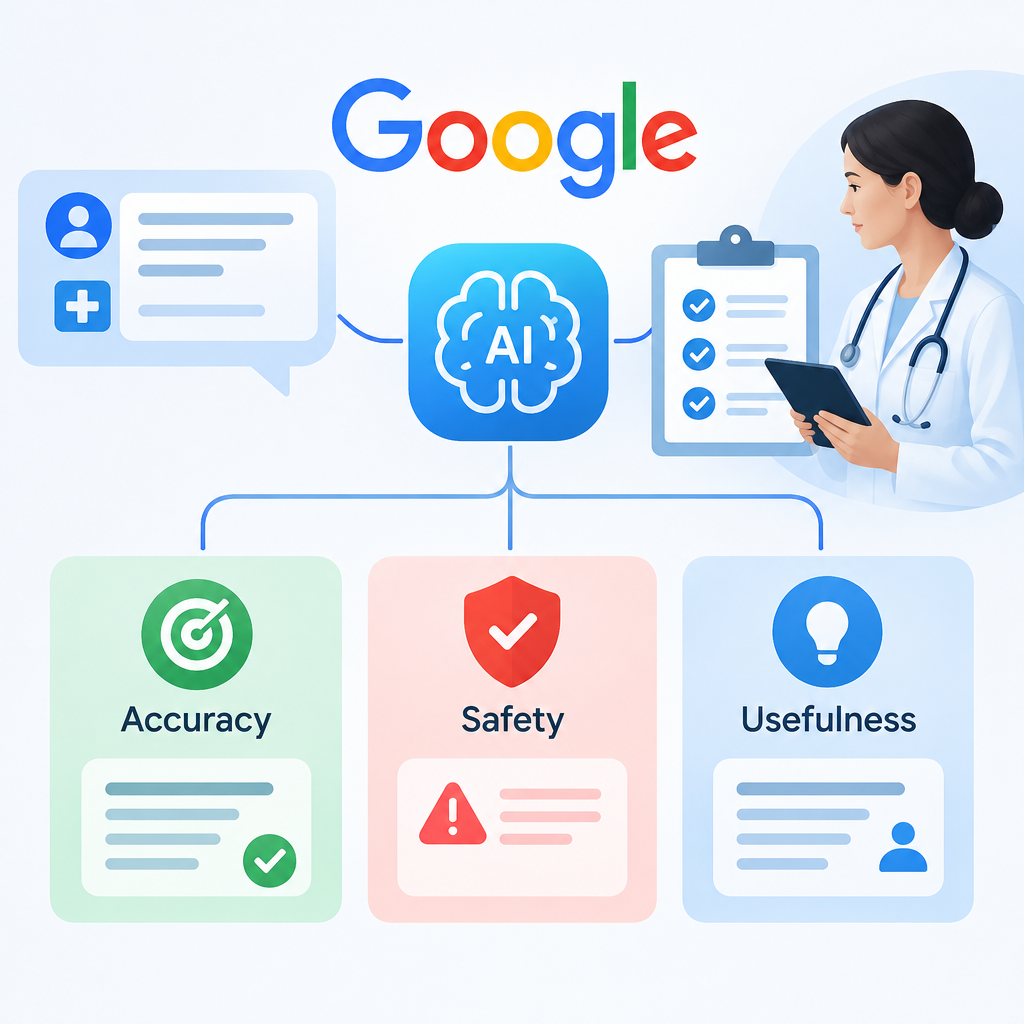
Google and health experts published a framework for evaluating AI use in health contexts across three areas: accuracy, safety and usefulness.
Key facts
The framework combines closed-question benchmarks, automated response ratings and human expert review for common and high-risk scenarios.
Google says it uses the framework to evaluate its own models' responses to health questions.
An objective look at what matters
Developers of health AI tools have an example of how to combine scalable tests with expert review of safety issues.
Business processes
Quality assurance for health AI tools — Teams could organize response evaluations around accuracy, safety and usefulness.
Automation opportunities
Evaluating AI responses: Automated raters could help assess responses alongside experts. Conditions: The framework is published, but adoption by other organizations has not been established.; High-risk scenarios require input from relevant experts.
Impact on manual work
Automated rating could handle some checks, but its effect on labor has not been measured.
Limitations and risks
The publication provides neither independent validation results for the framework nor evidence that a specific health product is safe.