AI security investigations, research agents, and election safeguards
Issue date:
This issue covers three internal uses of AI: security-alert investigation at Block, long-running agent research at Third Moment Research, and detection of election-related Claude misuse at Anthropic. In each case, automation works alongside human validation or review.
This issue may include important events published earlier.
Block reports a 50% increase in security-alert triage throughput
Block uses a system built on OpenAI Daybreak for vulnerability discovery, threat detection, and response. It helps assess alerts and prepare investigations. Block reports that initial triage throughput rose by 50%. The company says a person validates every result: automation does not make every security decision on the team’s behalf.
Key facts
Block reports a 50% increase in alert-triage throughput and says the volume of intelligence gathering and investigations also increased by 50%.
According to Block, a proposed detection change can be tested against seven months of telemetry in under an hour. Previously, that meant manually rerunning queries across hundreds of past cases.
OpenAI’s account describes a system that routes tasks to different models, allows a person to take over, and supports agents checking one another’s work. Block evaluates it against internal benchmarks and operational results.
Block reports that, in recent red-team exercises, the time from submitting a high-level vulnerability to an automatically proposed patch was 18 minutes. This measures time to a proposal, not to a verified, deployed fix.
An objective look at what matters
Initial triage determines which alerts need an analyst’s attention. Testing proposed rules against past data may make detection tuning faster and show which cases a rule would affect before it is deployed. But a link between records from different systems does not, by itself, prove an attack. Incident priority, investigative conclusions, and code changes need context that an agent may lack.
Business processes
Alert triage and incident investigation — The system may assemble records from several sources into a case summary. That could reduce repetitive searching for analysts, provided they check the underlying evidence.
Detection-rule tuning and vulnerability remediation — Historical telemetry can help test a proposed rule. For fixes, Block describes further steps: find the affected code and its owner, confirm exploitability, and verify the repair.
Automation opportunities
Collecting alert evidence and preparing an investigation: An agent could correlate logs and prepare a summary an analyst can verify. A person retains the ability to take over, assess the findings, and decide what action follows. Conditions: The account describes Block’s internal deployment, not confirmed availability of an off-the-shelf solution to other organizations.; Log-access limits, checks on the collected evidence, and rules for escalating ambiguous cases are needed.; Model routing and tests against historical data should be evaluated in the adopting organization’s own environment.
Impact on manual work
Block estimates that automating false-positive triage returned roughly 600 analyst-hours per quarter. This is a figure for one internal deployment reported in OpenAI’s account, not a verified saving for other teams.
Limitations and risks
The figures appear in the technology provider’s account of Block’s work; it offers no independent comparison across security teams.
Incorrectly correlated alerts or missing context could change an incident assessment. Block retains human validation and plans to move into more sensitive systems gradually.
A quick patch proposal is not a verified safe fix: confirming the vulnerability, checking the repair, and deploying it remain separate steps.
Third Moment Research describes running 10,000 agents concurrently
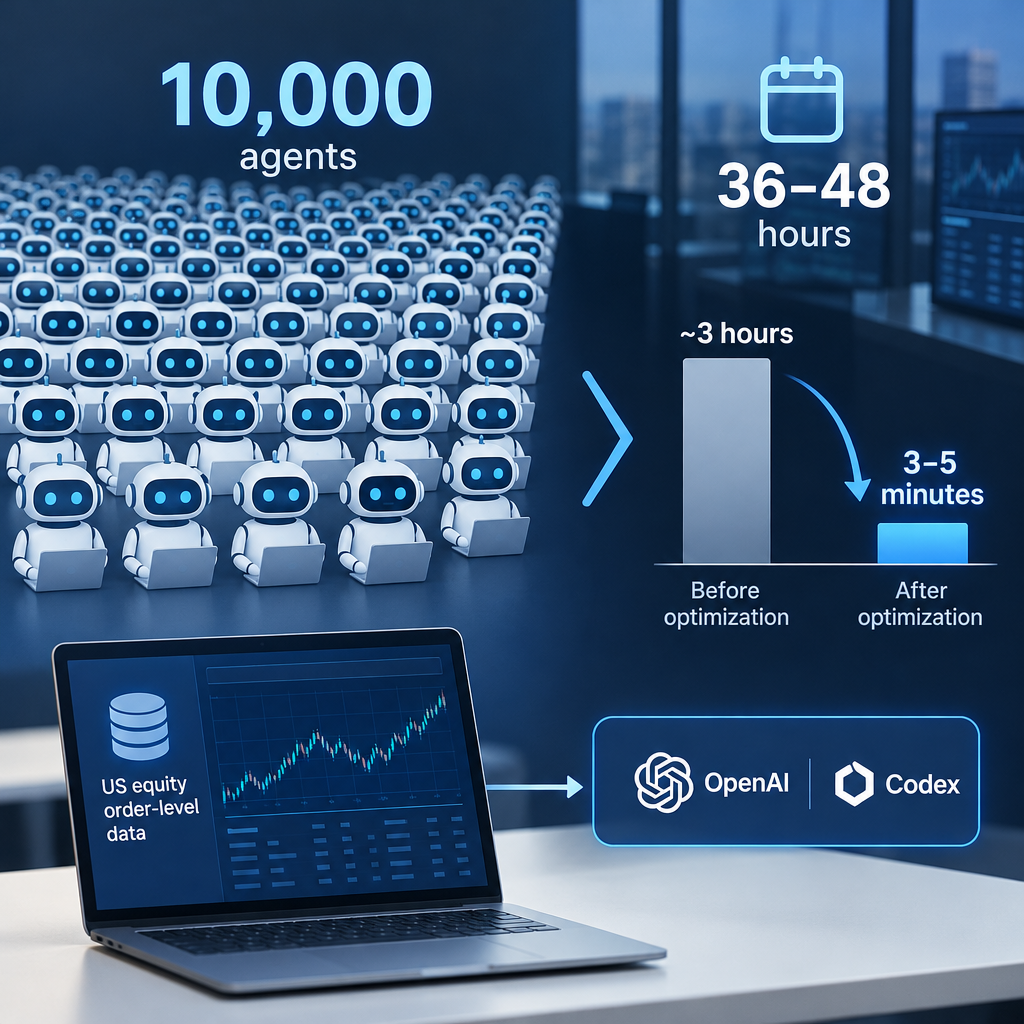
Third Moment Research says it runs 10,000 agents concurrently on investigations lasting 36–48 hours. In its internal environment, the agents use OpenAI models and Codex tools, including to test trading strategies on historical data. The company also describes optimizing one strategy backtest: changes to caching and memory handling cut its runtime from approximately three hours to approximately three to five minutes.
Key facts
Third Moment Research reports that its system runs 10,000 agents at once on investigations lasting 36–48 hours.
The company says Codex helped find a bottleneck in backtesting a strategy against a year of US equity order-level data. After optimization, the test fell from about three hours to about three to five minutes.
In Third Moment Research’s account, an outer control layer examines unfinished jobs and decides whether to retry them, stop them, or escalate them to human review.
The company uses Daybreak to test its environment before simulations start, including whether an agent could escape the research environment and access the wider network.
An objective look at what matters
When agents run for days and conduct many experiments, model answers are only part of the problem. Waiting for a slow test can consume their compute budget on repeated status checks instead of research. Reducing that wait helps this particular research environment; it does not establish that a resulting trading strategy will succeed. Long-running jobs also need clear rules for completion, retries, and handoff to a person.
Business processes
Quantitative research and historical strategy testing — Agents may conduct successive experiments and choose the next test based on earlier results. Findings still need to be distinguished from chance patterns in past data.
Managing long-running agent jobs — A control layer may notice a stalled investigation and route it for a retry, termination, or human review rather than leave an unfinished task unresolved.
Automation opportunities
Parallel experiments in an isolated research environment: Agents could run sequences of verifiable tests while a control layer tracks progress and escalates disputed outputs. This is a potential approach for work with clear success criteria, not a promise of similar scale at every company. Conditions: The account describes Third Moment Research’s internal system; availability as a packaged solution for others is not claimed.; Environment isolation, access and spending limits, experiment records, and reproducibility checks are needed.; Financial applications require independent assessment of results and compliance with applicable requirements.
Impact on manual work
Third Moment Research reports a shorter backtest and less token use while agents wait. The article does not quantify hours of manual work saved or show that the same effect would occur in another organization.
Limitations and risks
The agent count and backtest speedup are company figures published in an OpenAI article; no independent measurements for comparison are provided.
Historical strategy tests do not establish live-trading performance. Faster computation can also produce a mistaken conclusion faster.
Large agent populations raise costs and risks to data and infrastructure. The described isolation tests do not remove the need for ongoing controls.
Anthropic adds Claude safeguards against multi-step election abuse
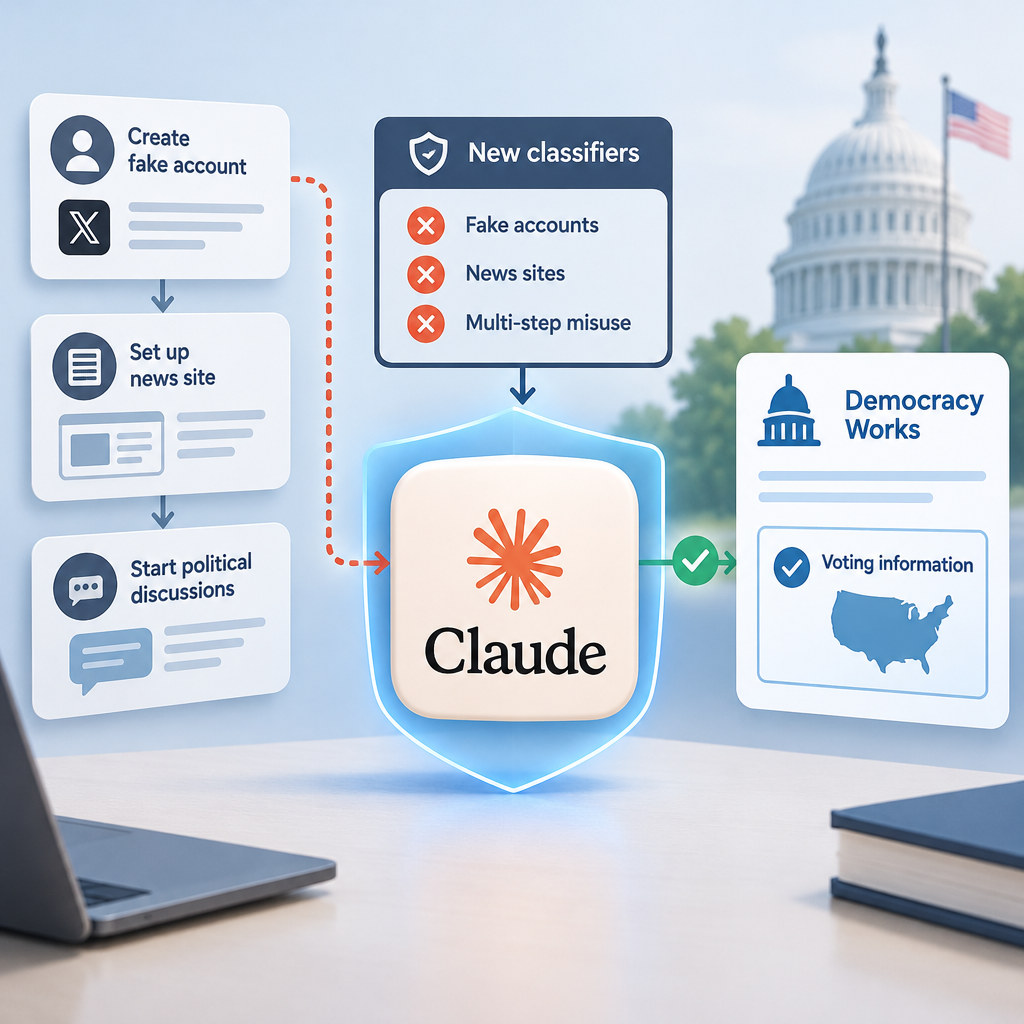
Anthropic has announced new classifiers for detecting election-related misuse of Claude. They are intended to better identify multi-step schemes whose individual requests may look harmless. The company also says that, later in October, Claude.ai will begin incorporating Democracy Works voting information into responses for users in the United States. It has not described that response feature as already launched.
Key facts
Anthropic added classifiers to detect novel and multi-step misuse, including attempts to create fake social-media accounts and news sites aimed at political discussions.
According to Anthropic, researchers from the Institute for Strategic Dialogue and the McCain Institute found that Claude reliably refused a direct harmful request but could miss a campaign divided into seemingly benign tasks.
Anthropic says its teams review flagged activity and, when they confirm a violation, take action that may include banning accounts.
Anthropic says that later in October Claude.ai will begin using Democracy Works information drawn from state and local sources to answer voting questions for users in the United States.
An objective look at what matters
Reviewing each request in isolation can miss the purpose of a chain of actions: audience research, setting up a site, and drafting material may not appear harmful separately. The reported tests explain the case for safeguards aimed at multi-step schemes. They do not establish that the new defenses will catch every evasion attempt. False alarms are also possible, so suspected violations need review and voting information needs to remain current.
Business processes
Investigating violations of an AI platform’s rules — Classifiers may flag activity resembling preparations for voter deception. Specialists need to review the context before acting against an account.
Providing voting reference information — Claude.ai already shows a TurboVote link for questions about registration, polling places, and election dates. Anthropic plans to add Democracy Works information directly to answers for US users later in October.
Automation opportunities
Detecting multi-step election-related misuse of Claude: Automated checks may flag suspicious activity for investigation by the platform team. This is an example of Anthropic’s own safeguards, not a classifier offered to other organizations. Conditions: Anthropic says it has added the classifiers to Claude’s safeguards; availability to third parties is not claimed.; Flagged activity needs review, and a suspected violation needs confirmation before an account is banned.; The planned Democracy Works responses apply to Claude.ai users in the United States and are not an already launched part of the classifiers.
Impact on manual work
Classifiers may help select cases for review, but Anthropic provides no figure for reduced manual work. It says its teams examine flagged activity and confirm violations.
Limitations and risks
The tests exposed a weakness in earlier safeguards against fragmented campaigns; the article does not establish that the new classifiers will detect every such scheme.
The measures protect Claude itself, rather than constitute a ready-made moderation product for other services. Missed abuse and false positives remain possible.
Voting information in responses for US users is planned for later, not described as live. Accuracy and timeliness of its source information will be particularly important.