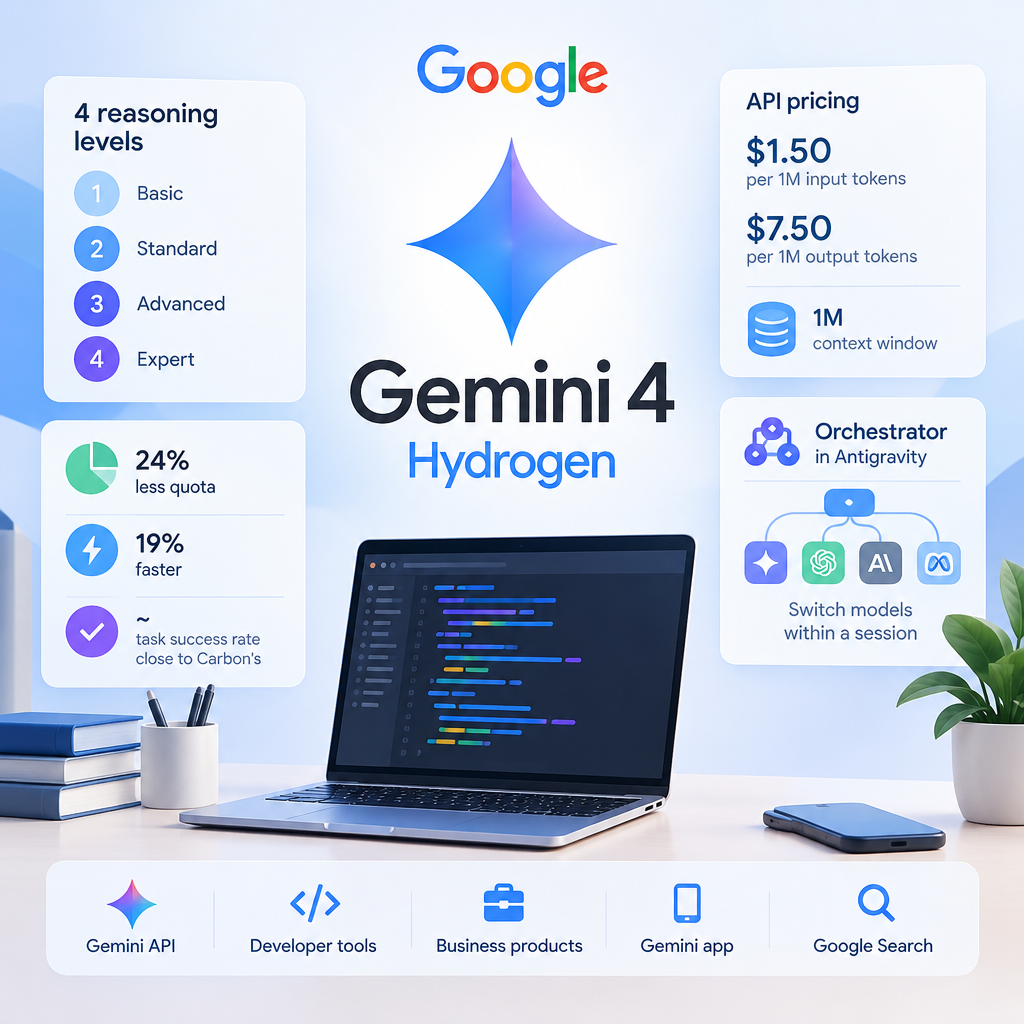
Google introduced Gemini 4 Hydrogen for coding and multistep tasks. The model is rolling out across the Gemini API, developer tools, business products, the Gemini app and Google Search.
Key facts
The model supports four reasoning levels. API pricing is $1.50 per million input tokens and $7.50 per million output tokens, with a one-million-token context window.
Google introduced Orchestrator in Antigravity to switch models within a session. Google says that on Terminal-Bench 4.0 it used 24% less quota on average and completed tasks 19% faster, with a task success rate close to Carbon’s.
Free Gemini app users can access the model through automatic selection. Individual access in Antigravity is for paid Google AI Pro and Ultra subscribers; in Sheets, access is for eligible business subscriptions and Pro and Ultra subscribers.
An objective look at what matters
Teams can choose a reasoning level and combine models for different stages of a task, balancing quality, response time and cost.
Business processes
Code development and review — The model could assist with code changes, tests and debugging.
Document and spreadsheet work — The model could prepare structured materials from files in different formats.
Automation opportunities
Multistep development using several models: Orchestrator can switch models during a session, while agents could execute and verify tasks in parallel. Conditions: Check Antigravity availability during the rollout and subscription terms.; Evaluate quality and cost on your own tasks.
Impact on manual work
Preparing code and materials may require less manual work, but the publications do not establish time savings for every team.
Limitations and risks
Google supplied the benchmark results; they do not guarantee the same effect in production.
Model outputs and agent actions require review; access depends on the product and subscription.
Microsoft details Frontier Company customer projects
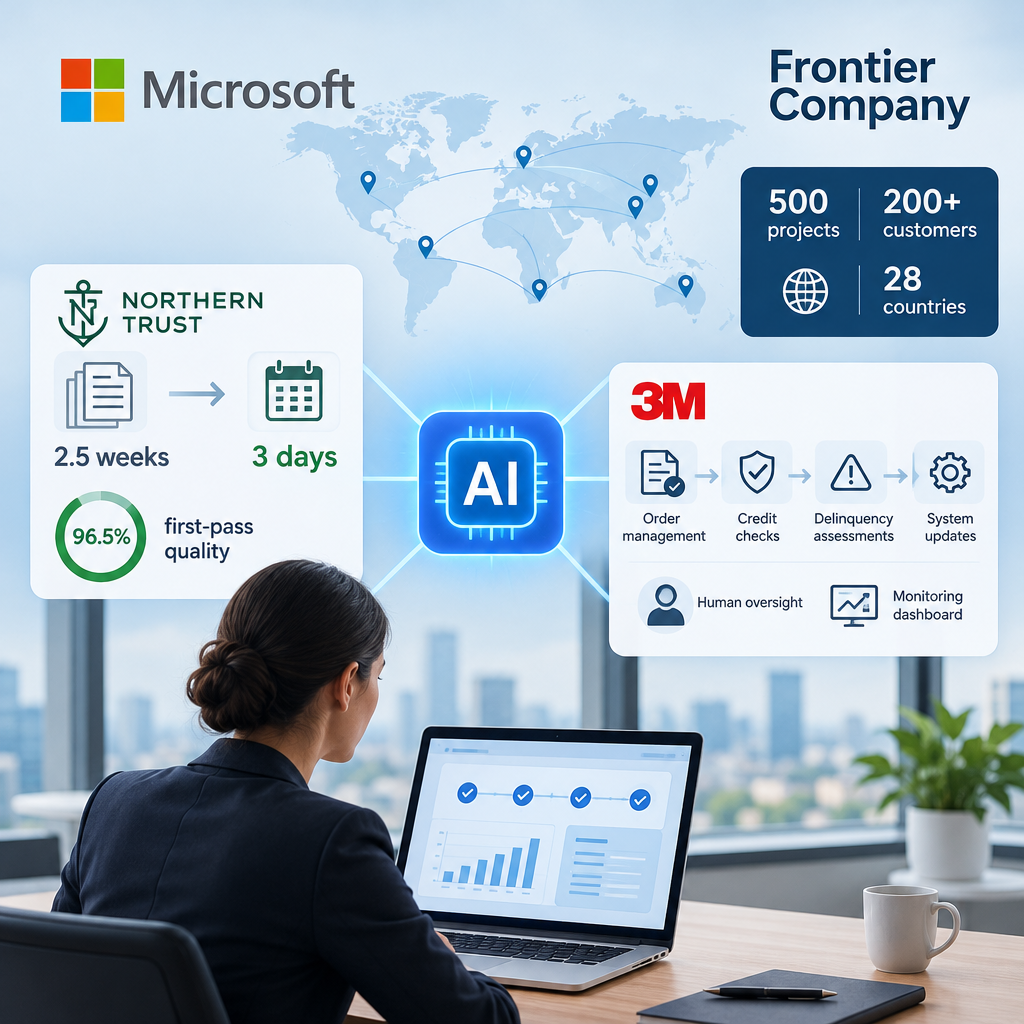
Microsoft says Frontier Company has worked on nearly 500 projects with more than 200 customers in 28 countries. It provided examples of deployments and solutions still under development.
Key facts
According to Microsoft, an agent for Northern Trust client onboarding reduced data preparation time from about two and a half weeks to three days, or 83%. First-pass quality was 96.5% in testing.
Microsoft and 3M are building an AI-agent workflow for order management, including credit checks, delinquency assessments and system updates. It includes human oversight and a monitoring dashboard.
An objective look at what matters
The examples show how agents can be integrated into existing workflows while keeping specialists involved in decisions.
Business processes
Client onboarding — Data preparation can take place in Excel and SharePoint, tools analysts already use.
Order management — Agents could assist with checks and system updates under employee supervision.
Automation opportunities
3M credit checks and order management: The solution under development could reduce manual work and speed up processing. Conditions: The solution is still being built; human review and monitoring are needed.
Impact on manual work
Microsoft expects less manual work at 3M. For Northern Trust, it reports reduced data preparation time but does not provide a separate measure of labor saved.
Limitations and risks
Microsoft supplied the results and forecasts; the publication presents no independent verification.
The Northern Trust results concern a specific process, and the quality figure comes from testing.
IDC research finds a gap between AI results and scaling them
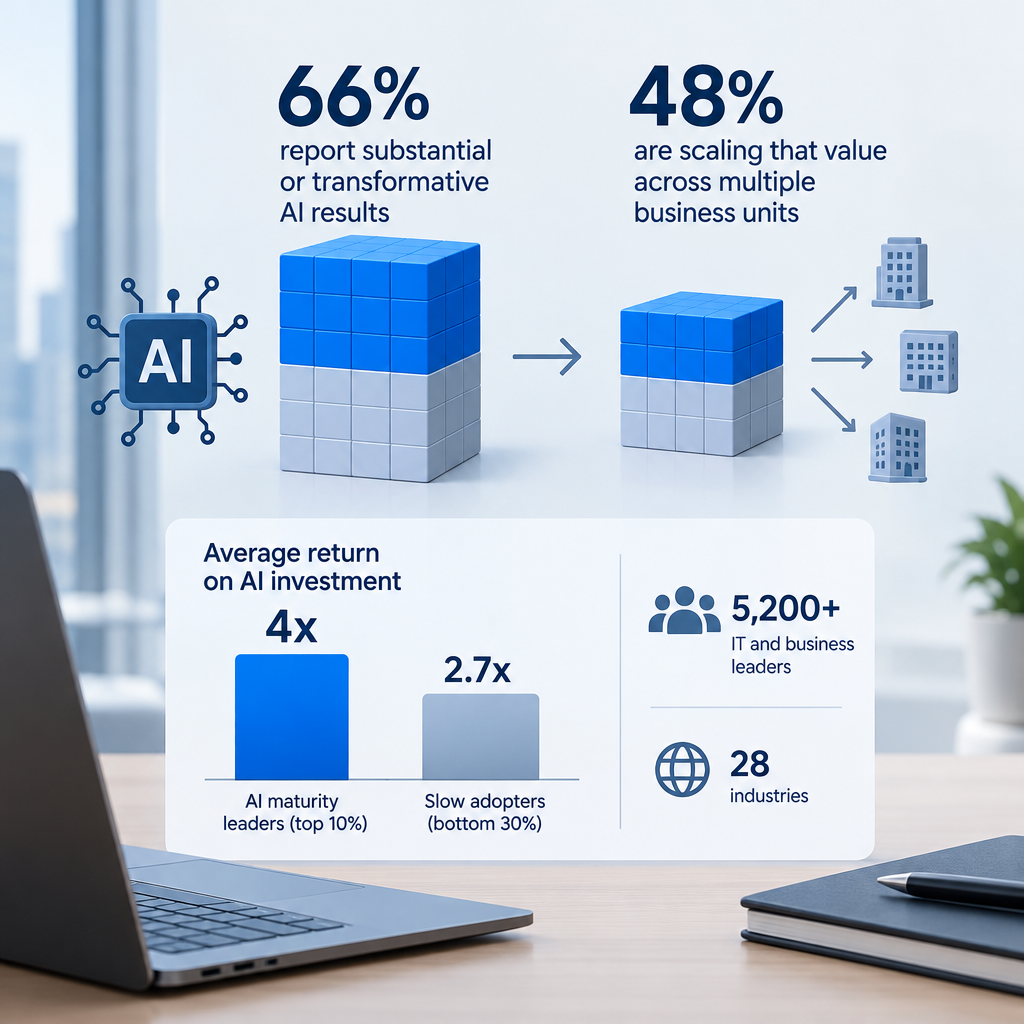
Microsoft presented findings from IDC research it commissioned, involving more than 5,200 senior IT and business leaders across 28 industries.
Key facts
According to the research, 66% of leaders report substantial or transformative AI results, but only 48% are scaling that value across multiple business units.
AI maturity leaders—the top 10% on IDC’s scale—reported an average 4x return on AI investment, compared with 2.7x for slow adopters in the bottom 30%.
According to the Microsoft-commissioned IDC research, 65% of organizations have a process for governing agents, but only 20% have a comprehensive, organization-wide AI skills strategy.
An objective look at what matters
To scale adoption, companies can measure outcomes by workflow while planning agent oversight and employee training.
Business processes
AI investment management — Comparing measures before and after adoption could help direct spending toward useful applications.
Automation opportunities
Planning agent deployments: The findings could help select workflows for pilots and define oversight requirements. Conditions: Test the findings against your own workflows and data.
Impact on manual work
The research describes adoption and returns overall, but does not establish manual labor savings for a particular company.
Limitations and risks
Microsoft commissioned the research; return figures are reported by leaders.
The association between maturity and returns does not establish causation.