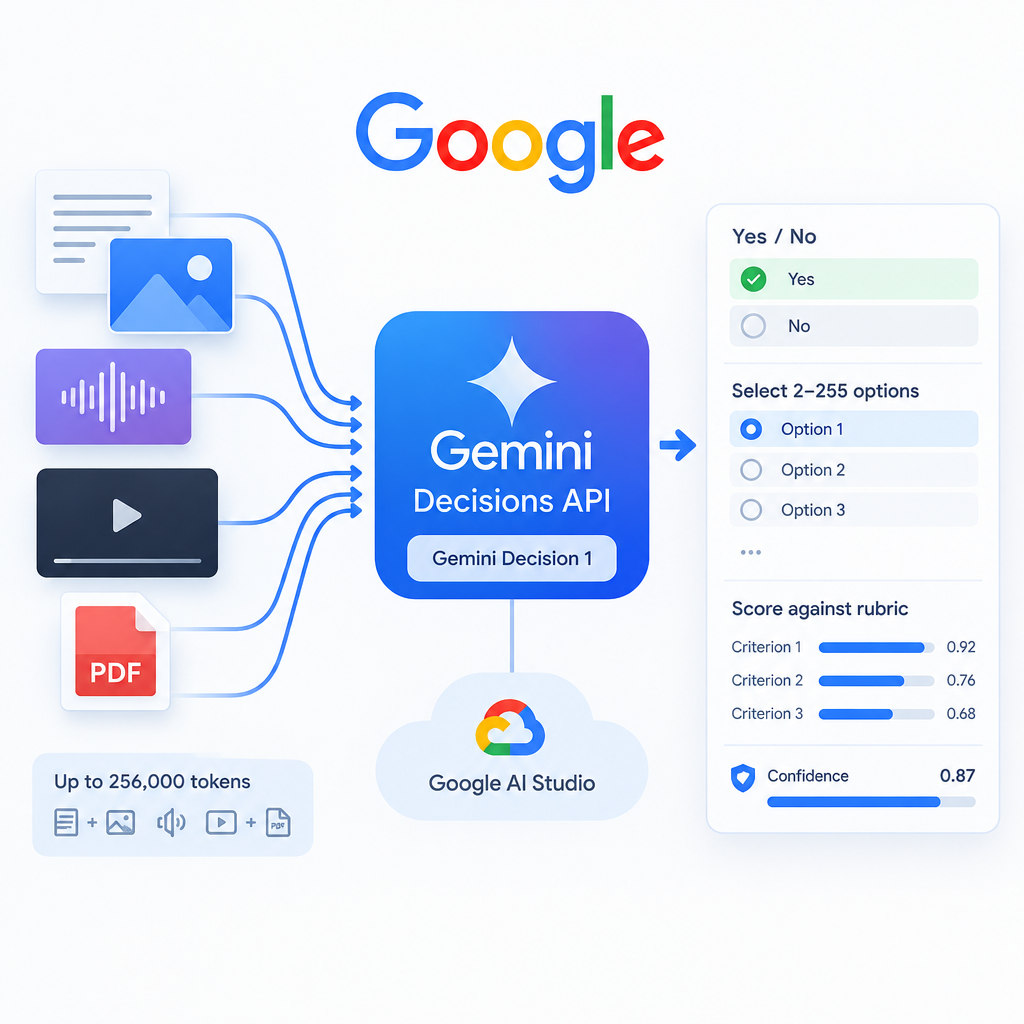
Google introduced Gemini Decisions API and the Gemini Decision 1 model. They evaluate predefined options rather than generate free-form answers. The API is available through the Gemini API in Google AI Studio.
Key facts
A single request can include text, images, audio, video and PDFs totaling up to 256,000 tokens, along with up to 1,000 independent questions.
The API supports yes/no checks, selection from 2–255 options and scoring against an ordered rubric. Answers include a confidence score.
Google reports end-to-end latency of 150–250 ms for contexts up to 16,000 tokens. Pricing is $0.10 per million input tokens, with no output-token charge. A free API tier is available for prototyping.
An objective look at what matters
The API could simplify selection of the next step in an AI workflow when the options are known in advance.
Business processes
Request routing and tool selection — A system could direct requests to a suitable model or tool using predefined criteria.
Automation opportunities
Checking incoming materials: Teams could evaluate several conditions against a shared set of materials and send ambiguous cases to a person. Conditions: Options and criteria must be defined in advance.; Confidence thresholds and decision quality should be tested on the organization’s own data.
Impact on manual work
Some routine checks could be delegated to the system, but a reduction in manual work in a specific process has not been demonstrated.
Limitations and risks
The stated latency applies to Google’s specified conditions; other scenarios require measurement.
An inaccurate confidence estimate could lead to incorrect routing.
Google Cloud opens Professional Agentic Architect certification
Google Cloud announced that its certification is available to professionals who design, build and deploy AI agents on Google Cloud.
Key facts
The certification combines a proctored multiple-choice exam with hands-on Google Skills labs.
Preparation can begin at no cost: Gemini Agent Ready participants receive 35 learning credits per month for access to labs and courses.
An objective look at what matters
The certification gives teams another way to assess practitioners’ knowledge and hands-on skills before working on agents for multistep workflows.
Business processes
Training AI agent practitioners — Employers could use the exam and practical labs as one indicator of a professional’s preparation.
Automation opportunities
Building agents for multistep, multi-application workflows: Trained practitioners could apply their skills to developing such solutions. Conditions: The certification is available; applying the skills depends on the project and infrastructure.
Impact on manual work
The certification itself does not automate work, and outcomes from future projects have not been demonstrated.
Limitations and risks
A certificate does not guarantee the quality or security of a particular implementation.
AlphaGenome 2 predicts how DNA variants affect cell types
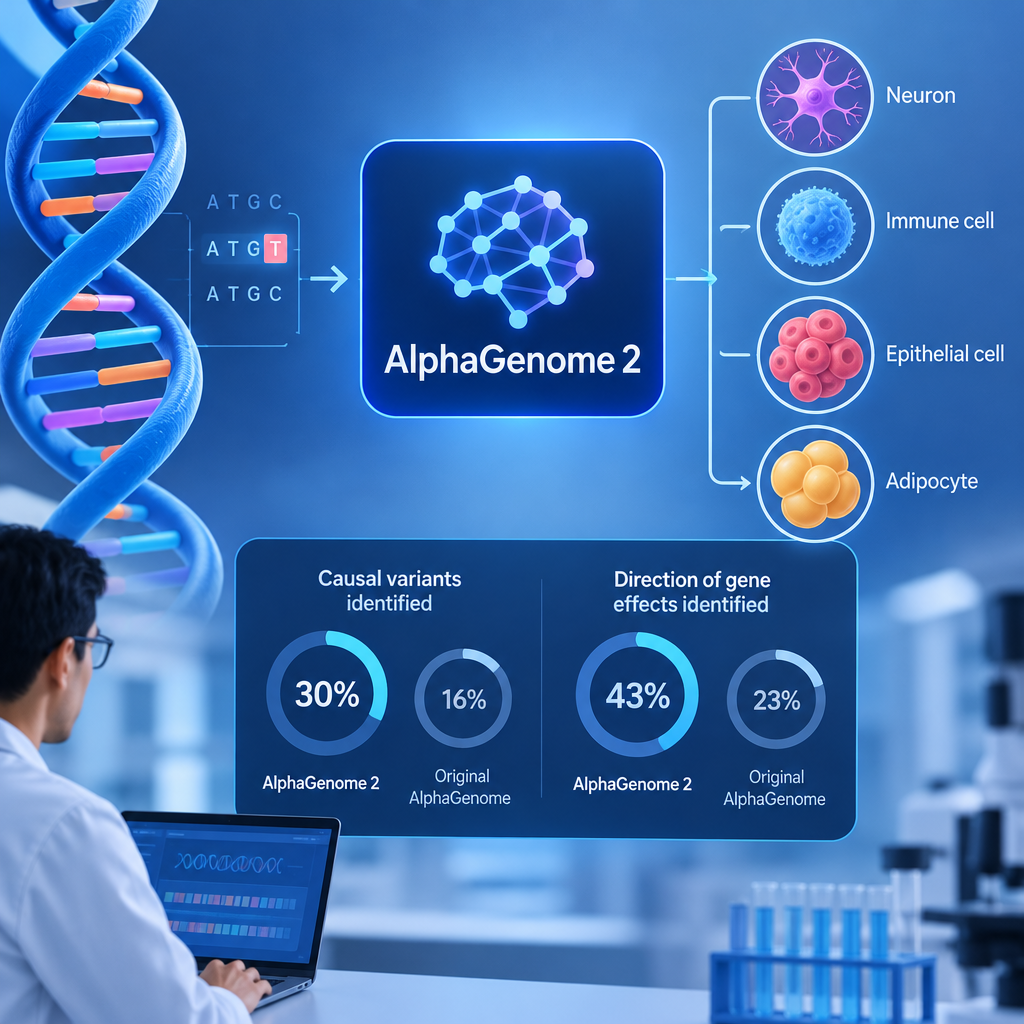
Google DeepMind introduced AlphaGenome 2 to predict how DNA sequences and their variants affect specific cell types and states. The model is available via API for non-commercial research, with a private preview for commercial researchers.
Key facts
The model was trained on human and mouse data, including more than 107 million individual cell profiles.
Google DeepMind reports that on the TenK10K dataset, the model identified 30% of causal variants, versus 16% for the original AlphaGenome fine-tuned on single-cell data. For identifying the direction of gene effects, the figures were 43% and 23%.
An objective look at what matters
Cell-specific predictions could help researchers select DNA variants and experiments for further investigation.
Business processes
Planning genetics research — Research teams could rank candidate DNA variants before conducting experiments.
Automation opportunities
Analyzing DNA variants: The API could generate predictions to help select promising variants. Conditions: Commercial research access is limited to a private preview.; Predictions require experimental validation.
Impact on manual work
The model could help with preliminary variant selection, but time savings for a particular team have not been demonstrated.
Limitations and risks
The model is intended for research only and has not been validated or approved for clinical or diagnostic use.
The comparative results come from a specific dataset and do not guarantee the same accuracy in other settings.