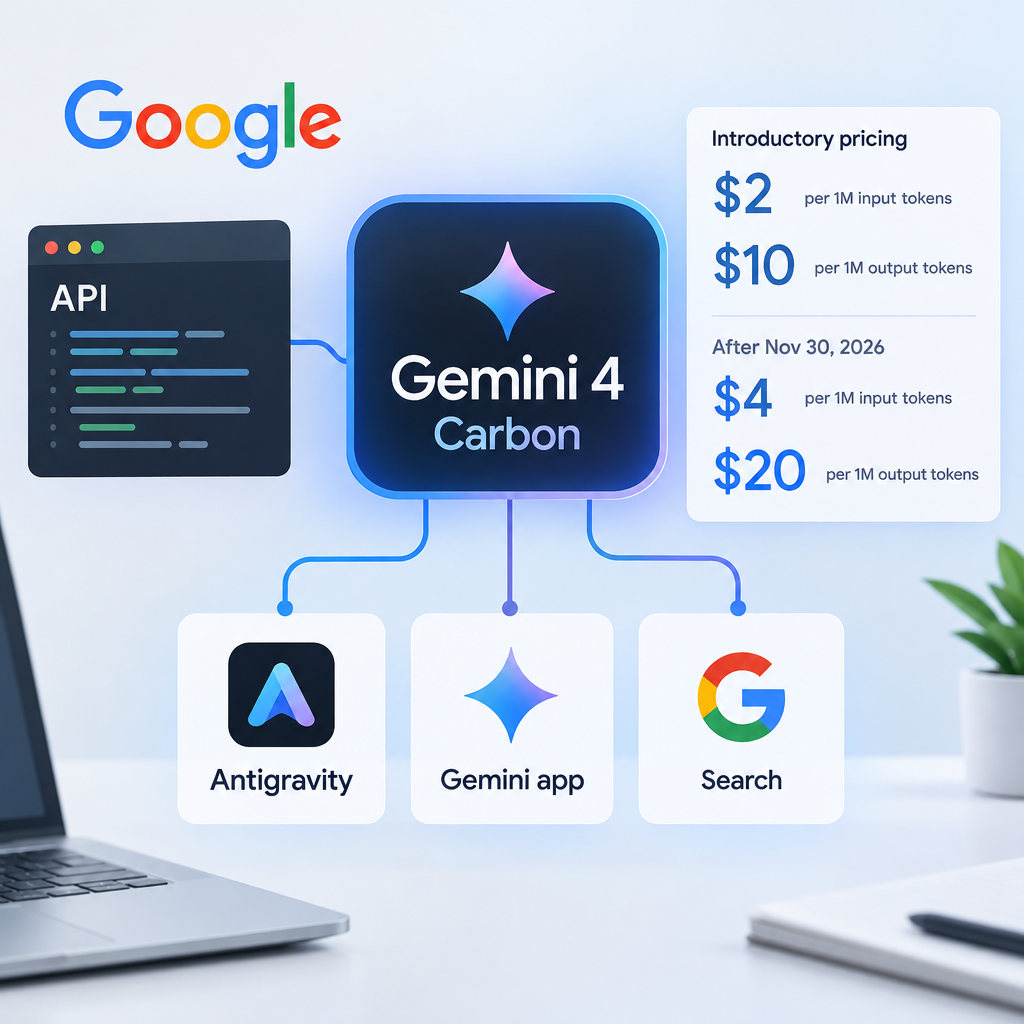
Gemini 4 Carbon is available to paying developers and enterprises through an API, an interface for connecting the model to applications. Google is also rolling it out across other products.
Key facts
Introductory pricing is $2 per million input tokens and $10 per million output tokens. After the introductory period ends on November 30, 2026, the public-access model will cost $4 and $20 respectively.
Google is previewing /swarm in Antigravity for coordinating multiple AI agents. Carbon is also rolling out in Antigravity, the Gemini app and AI Mode in Search for Google AI Ultra subscribers.
Google says Carbon ranked first on CursorBench 4.0, WANDR and AutomationBench at less than half the cost per task of the next-best external model.
An objective look at what matters
Businesses can connect the model to complex development and analysis tasks, but vendor-reported benchmarks are no substitute for testing on their own data.
Business processes
Software development and document analysis — The model could assist with multi-step coding, debugging and preparing materials.
Automation opportunities
Preparing and reviewing code changes: Agents could divide tasks and check proposed changes. Conditions: /swarm is a preview; Carbon access depends on the product and subscription.; Expert code review and token spending controls are needed.
Impact on manual work
The model may reduce some manual work, but the effect depends on the task and the review required.
Limitations and risks
The paid API is available now; rollout across other products is gradual.
Model errors and attacks through instructions embedded in processed data require safeguards and review.
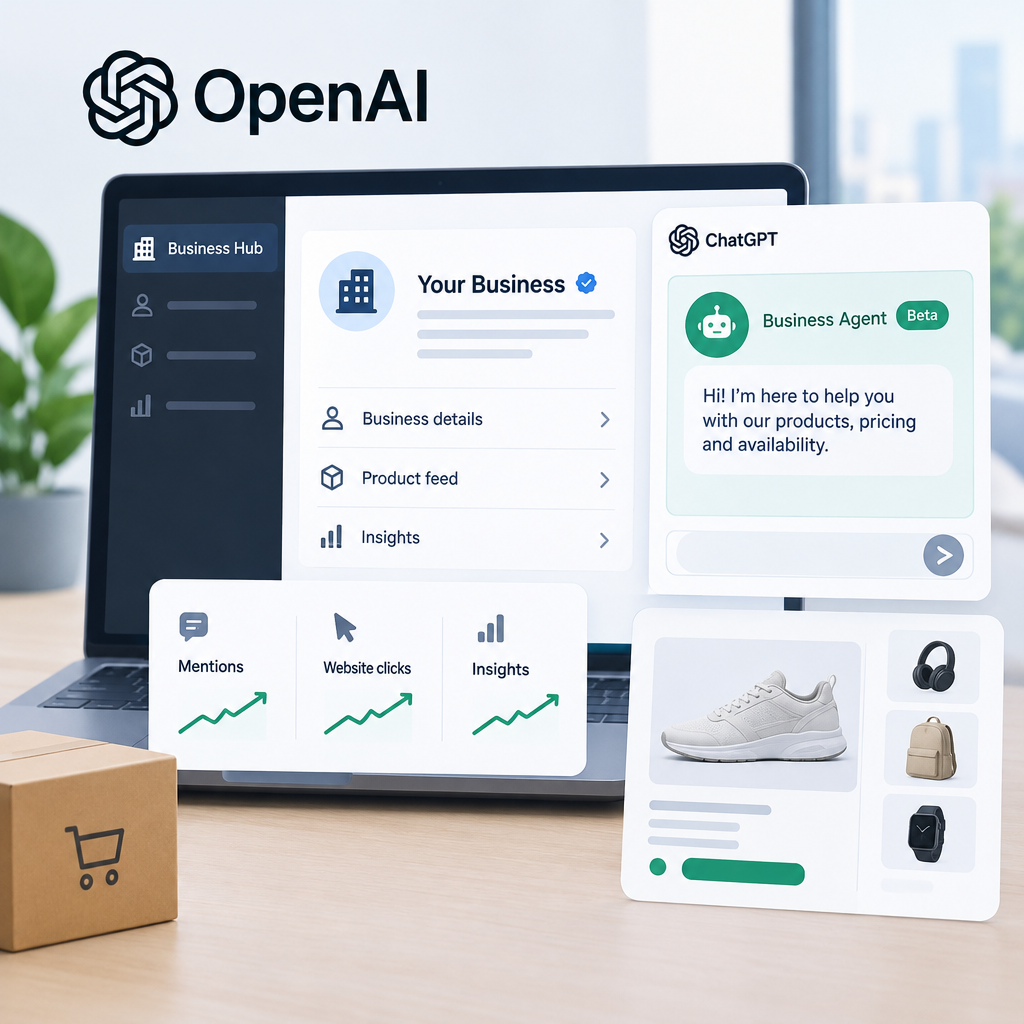
Business Hub lets companies claim their profiles, manage information and access aggregated insights. Eligible companies can also create Business Agents to interact with customers.
Key facts
Once verified, companies can update their details and add product feeds with pricing and availability. Insights include mentions and website clicks and are available when interaction thresholds are met.
Business Agents are available to eligible ecommerce and online service businesses in the United States. Agent conversations are clearly labeled and separate from the user's original ChatGPT conversation.
OpenAI says it does not share users' conversations or Business Agent chats with businesses.
An objective look at what matters
Businesses gain a channel within ChatGPT to present their offerings and answer customer questions.
Business processes
Product information and customer engagement — Customers can ask about offerings, while businesses can examine aggregated interest.
Automation opportunities
Answering questions about offerings: A Business Agent could answer questions and help customers compare options using company information. Conditions: The business must claim its profile and meet US agent eligibility requirements.; Product information needs to be kept current, and agent answers reviewed.
Impact on manual work
An agent could handle some routine questions, but the publication does not quantify labor savings.
Limitations and risks
The product is in beta; agent access is limited to certain business categories in the US.
Errors or outdated information could affect answers to customers.
AlphaProof Code helped verify properties of Signal protocol code
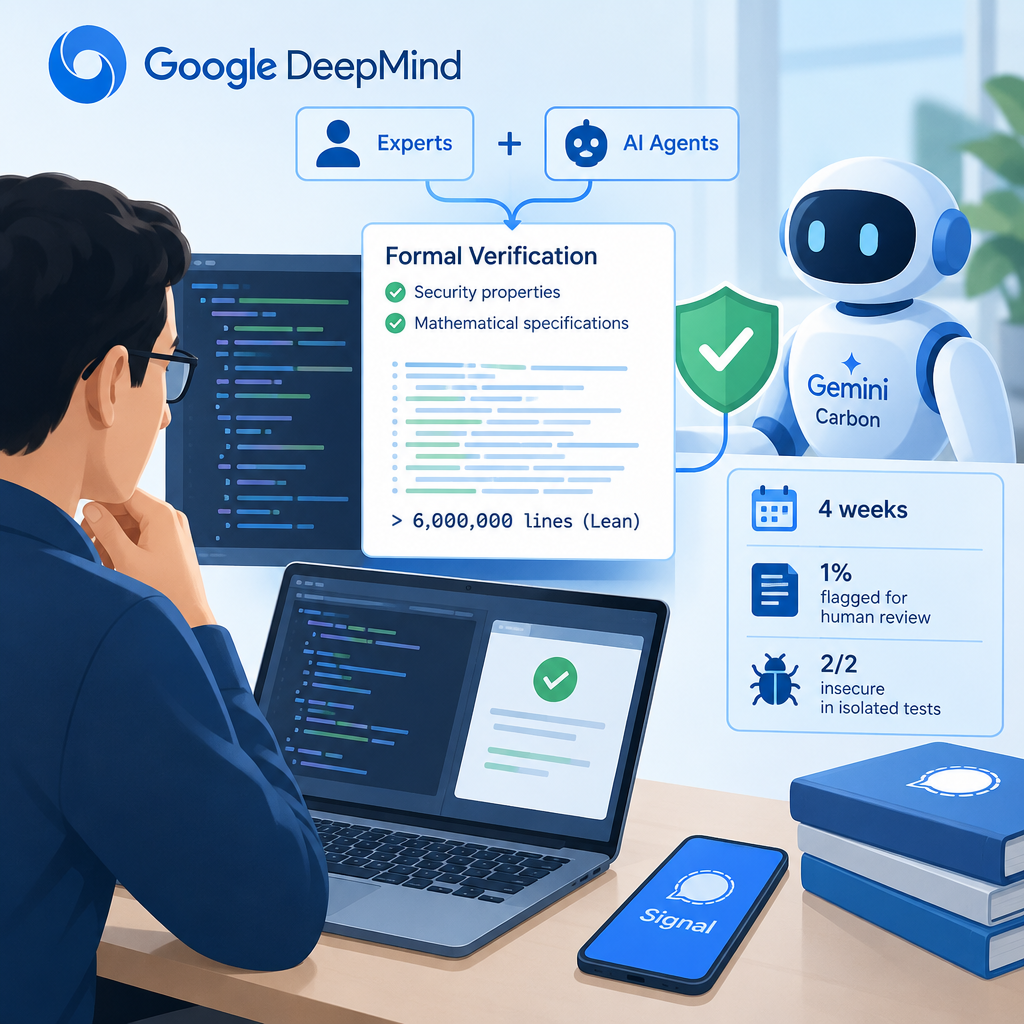
Google DeepMind introduced AlphaProof Code, a research system in which experts and AI agents collaborate on formal verification: mathematically proving specified properties of code.
Key facts
Researchers formulated and reviewed mathematical specifications for security properties. Gemini Carbon-powered agents produced proofs comprising more than six million lines in the Lean language.
Google DeepMind says verification took four weeks and agents flagged 1% of the codebase for additional human attention. In two isolated tests with previously fixed bugs reintroduced, the system proved the code insecure.
Google DeepMind is open-sourcing the formal verification artifacts for community use.
An objective look at what matters
The approach shows a way to verify properties of a cryptographic protocol's implementation, not just its design.
Business processes
Security review of critical software — Similar techniques could eventually help experts verify specified properties of other systems.
Automation opportunities
Developing and checking mathematical proofs: AI agents could help produce proofs while experts define and review the specifications. Conditions: Scaling the approach requires further research and domain experts.
Impact on manual work
Google reports less need for additional human review in this study; the result has not been shown to generalize to other projects.
Limitations and risks
The proofs cover specified properties and do not guarantee the absence of all vulnerabilities.
The method remains research and requires further work to scale.