Anthropic releases Claude Fable 5.2 and opens Mythos 5.2 to vetted organizations
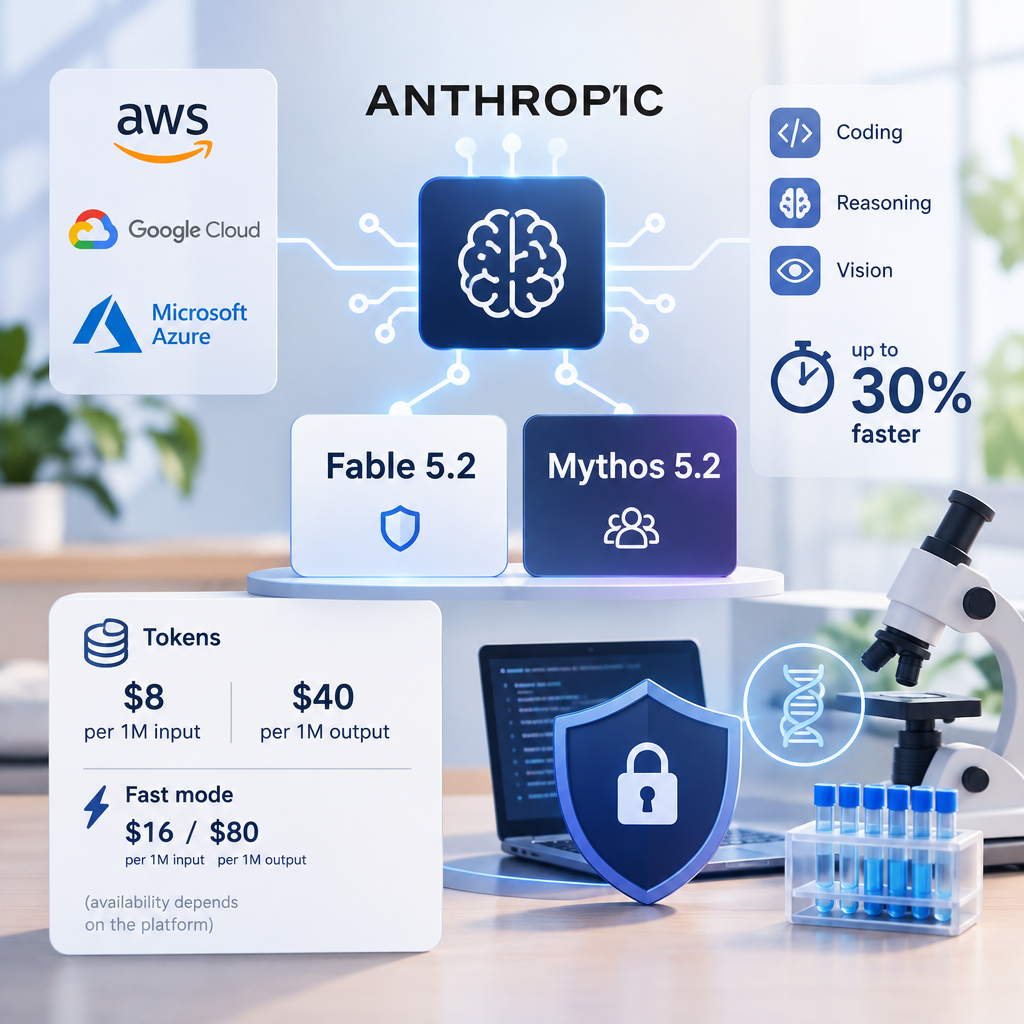
Fable 5.2 is available across platforms, including AWS, Google Cloud and Microsoft Azure. Cybersecurity professionals and life sciences researchers can apply for verification to access Mythos 5.2. Both versions share the same underlying model, but Fable has additional safeguards for those fields.
Key facts
Anthropic reports improvements in coding, reasoning and vision. It says the new versions generate responses up to 30% faster than their predecessors.
Pricing is $8 per million input tokens and $40 per million output tokens. Tokens are units used to measure model input and output. Fast mode costs $16 and $80 respectively; its availability depends on the platform.
Anthropic reports that Fable 5.2 scored 49.1% on FrontierCode 2.0 at Xhigh effort. This is a vendor test result, not a guarantee of performance on workplace tasks.
An objective look at what matters
Organizations can evaluate the models for complex development and research, but the choice depends on cost, safeguards and performance on their own tasks.
Business processes
Software development and maintenance — The models may help with code changes, debugging and service migrations.
Cybersecurity and life sciences research — Vetted organizations can evaluate Mythos for specialized tasks.
Automation opportunities
Preparing and checking code changes: Fable may suggest changes and assist with tests under a developer’s supervision. Conditions: Human code review and an assessment of token costs are needed.
Vulnerability research: Mythos may help analyze code in permitted scenarios. Conditions: Direct Mythos access requires organizational verification; findings need expert review.
Impact on manual work
The model may reduce some manual coding work, but the reported results have not been shown to transfer to a particular team.
Limitations and risks
Fable blocks many cybersecurity and research biology requests.
Mythos fast mode is available only to organizations in the verification programs.
Tests and speed estimates come from Anthropic; model outputs need verification.
Google introduces TPU 8tx and 8i Max for confidential AI and long contexts
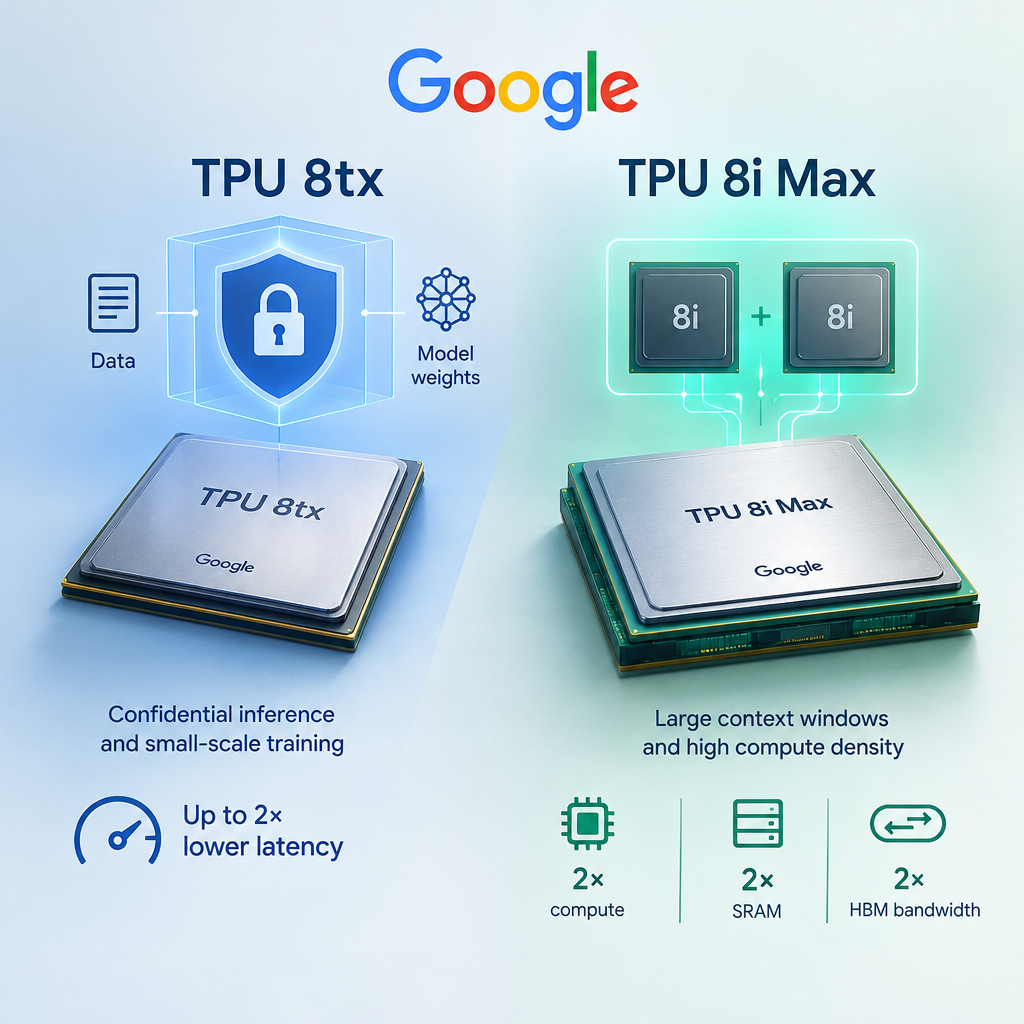
Google announced two eighth-generation TPU systems, specialized accelerators for AI. TPU 8tx is designed for confidential model inference and small-scale training. TPU 8i Max targets large context windows and high compute density.
Key facts
Google says TPU 8tx protects and isolates data and model weights during processing. The company claims up to twice as low latency as TPU 8t.
Google says 8i Max combines two TPU 8i chips and doubles compute, SRAM capacity and HBM bandwidth compared with 8i.
An objective look at what matters
Protecting data during processing and handling large contexts matter to organizations planning to run AI on sensitive data or analyze large volumes of information.
Business processes
Handling sensitive data — TPU 8tx may support protected model fine-tuning and execution.
Analyzing large information sets — TPU 8i Max may help process long contexts such as codebases or video.
Automation opportunities
Running AI agents on sensitive data: Protected infrastructure may allow organizations to automate individual steps without moving data between separate clusters. Conditions: Availability dates for the new systems were not provided; security and performance need evaluation against the intended workload.
Impact on manual work
The systems may support automation, but the article does not demonstrate a reduction in users’ manual work.
Limitations and risks
Google did not provide availability dates for TPU 8tx or 8i Max.
Specifications and performance estimates come from the vendor; actual effects depend on the workload.
OpenAI deploys Control Room to stop research workloads
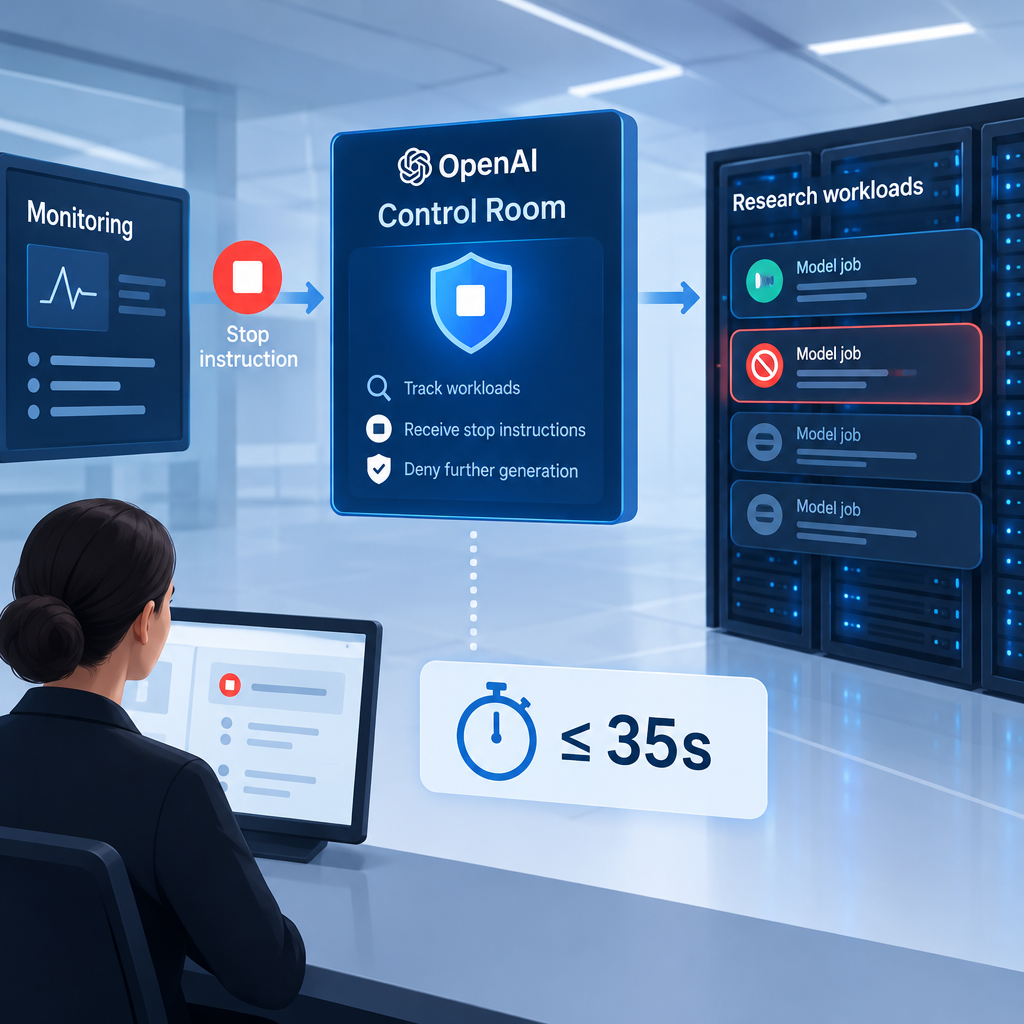
OpenAI has deployed Control Room across its research infrastructure. The system tracks model workloads and denies further generation when it receives an instruction to stop a job.
Key facts
OpenAI says a job can no longer make progress at most 35 seconds after a stop instruction is received. The delay comes from cached authorization checks.
According to OpenAI, the system can receive stop instructions from monitoring. If Control Room fails, model requests are denied: this fail-closed mode is already deployed for frontier-model research and is being rolled out to other research workloads.
An objective look at what matters
The system illustrates how centralized controls can limit further model activity when a risk is detected. It does not replace the monitoring needed to identify a problem.
Business processes
AI research safety — Centralized control can prevent further generation for stopped jobs.
Automation opportunities
Responding to a monitoring alert: Within OpenAI, monitoring can send a stop instruction without manual intervention. Conditions: Control Room is deployed in OpenAI’s internal research infrastructure and is not offered as an external product.
Impact on manual work
Automatically issuing a stop instruction may reduce manual involvement in some interventions, but OpenAI does not quantify labor savings.
Limitations and risks
Stopping is not instantaneous: the stated maximum is 35 seconds after the instruction is received.
Fail-closed operation is still being rolled out to the remaining research workloads.