AI-agent containment, faster storage, and an AI safety agreement with NASK
Issue date:
This issue covers three OpenAI announcements on security and infrastructure: agent-led testing of research-environment containment, changes to the Habitat storage platform, and an agreement with Poland’s NASK research institute.
This issue may include important events published earlier.
OpenAI disclosed results of testing containment for AI training environments
OpenAI said that agents in a large-scale testing effort found previously unknown software vulnerabilities and research-infrastructure misconfigurations. According to the company, the findings enabled sandbox escapes, movement between systems, limited internet access, and communication across isolation boundaries. It said it remediated the weaknesses, paused training and evaluation of its most capable models, and resumed frontier reinforcement-learning training and internal inference on October 1 with stronger safeguards. OpenAI also adopted a policy of training frontier models without internet access until advances in safeguards justify broader access.
Key facts
OpenAI reported that agents found vulnerabilities and misconfigurations affecting sandboxes, network boundaries, and isolation between agents.
OpenAI said it remediated the weaknesses its agents found and made large-scale agent-led testing of defenses part of its safety cases for future training and evaluation runs.
The company said it resumed frontier reinforcement-learning training and internal inference on October 1, 11 days after its pause began.
An objective look at what matters
A sandbox alone does not ensure that an agent will stay within authorised boundaries. Teams running agents may need independent layers of protection: execution restrictions, network rules, access controls, monitoring, and automatic stopping of risky runs. Testing should cover cloud configuration and connected services, not only agent code.
Business processes
Development and testing of AI agents — May require formal containment testing before agents are allowed to access internal systems or external services.
Cloud infrastructure security management — May strengthen recurring reviews of configurations, permissions, network paths, and monitoring signals.
Automation opportunities
Continuous checks of configurations and access boundaries in agent environments: Automatically detect changes that create prohibited network paths, excessive permissions, or interaction between isolated tasks. Conditions: An up-to-date infrastructure inventory and access-policy model are needed.; Automated blocking must be tested to avoid stopping critical work through false positives.; Checks do not replace human investigation and remediation of complex vulnerabilities.
Impact on manual work
Automated checks and run-stopping controls may reduce manual detection of common configuration errors. Security engineers still need to validate findings, assess impact, and remediate issues.
Limitations and risks
This describes OpenAI's internal infrastructure, not an off-the-shelf product for external deployment.
OpenAI expects future models may find vulnerabilities that are not yet known.
The company says fully disconnecting its research infrastructure from external networks is currently impractical because experiments need external connections to operate and be monitored.
OpenAI reported a 12x improvement in Habitat read latency
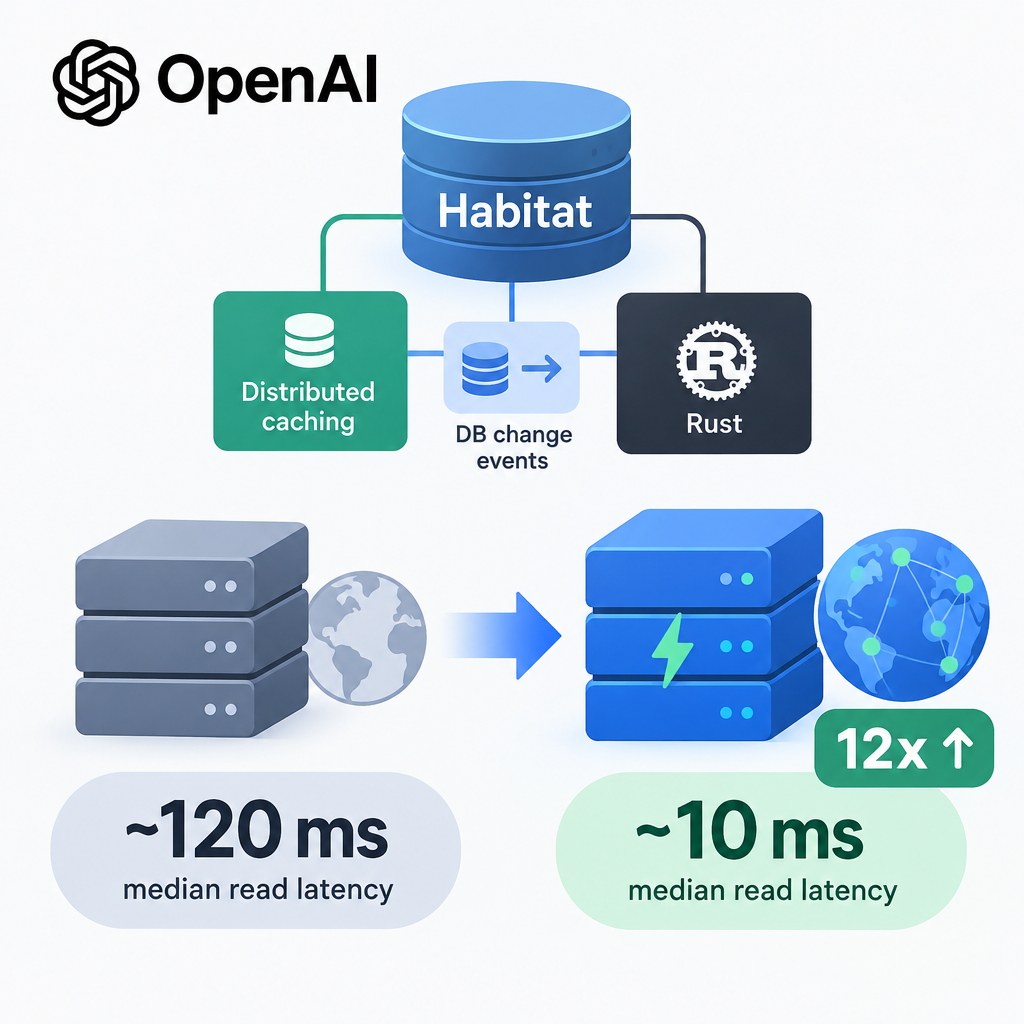
OpenAI reported changes to Habitat, its online storage platform. The company added distributed caching that is updated through database change events and rewrote the service from Python in Rust. OpenAI estimated that global median read latency fell from roughly 120 ms to roughly 10 ms, a 12x improvement.
Key facts
Habitat is OpenAI's internal online storage platform for fast product access to data.
OpenAI said integrated distributed caching and rewriting the service in Rust reduced global median read latency from roughly 120 ms to roughly 10 ms.
According to OpenAI, the cache uses a database change feed to propagate signals to invalidate local copies globally within seconds.
An objective look at what matters
Storage latency affects user flows and services that fetch data for agents. A common caching layer can reduce the need for every product team to build separate caches, batch requests, and work around slow reads. However, faster median requests do not remove the latency of reads that miss the cache.
Business processes
User-facing and agent-service access to operational data — Faster reads can reduce waits in flows where services repeatedly fetch settings, state, or metadata.
Storage capacity planning and operations — A shared storage layer for multiple teams can reduce manual planning work for individual products if workload isolation is retained.
Automation opportunities
Distributed cache updates after data changes: Automatically invalidate local object copies after changes in the primary database instead of relying only on cache expiration. Conditions: A reliable change stream and delivery-failure handling are required.; Each process needs a defined tolerance for stale data.; Critical records need consistency checks and a rollback strategy.
Impact on manual work
Centralised caching and change management can reduce manual cache tuning and scaling work for product teams. Operating a large distributed platform still requires specialised engineering.
Limitations and risks
The metrics are OpenAI's results for its own platform and do not establish the same outcome in another architecture.
Cache-miss requests still reach underlying storage, sometimes across regions.
Data placement is constrained by available cloud capacity, and caching can return stale data.
OpenAI and NASK signed an agreement on AI safety collaboration
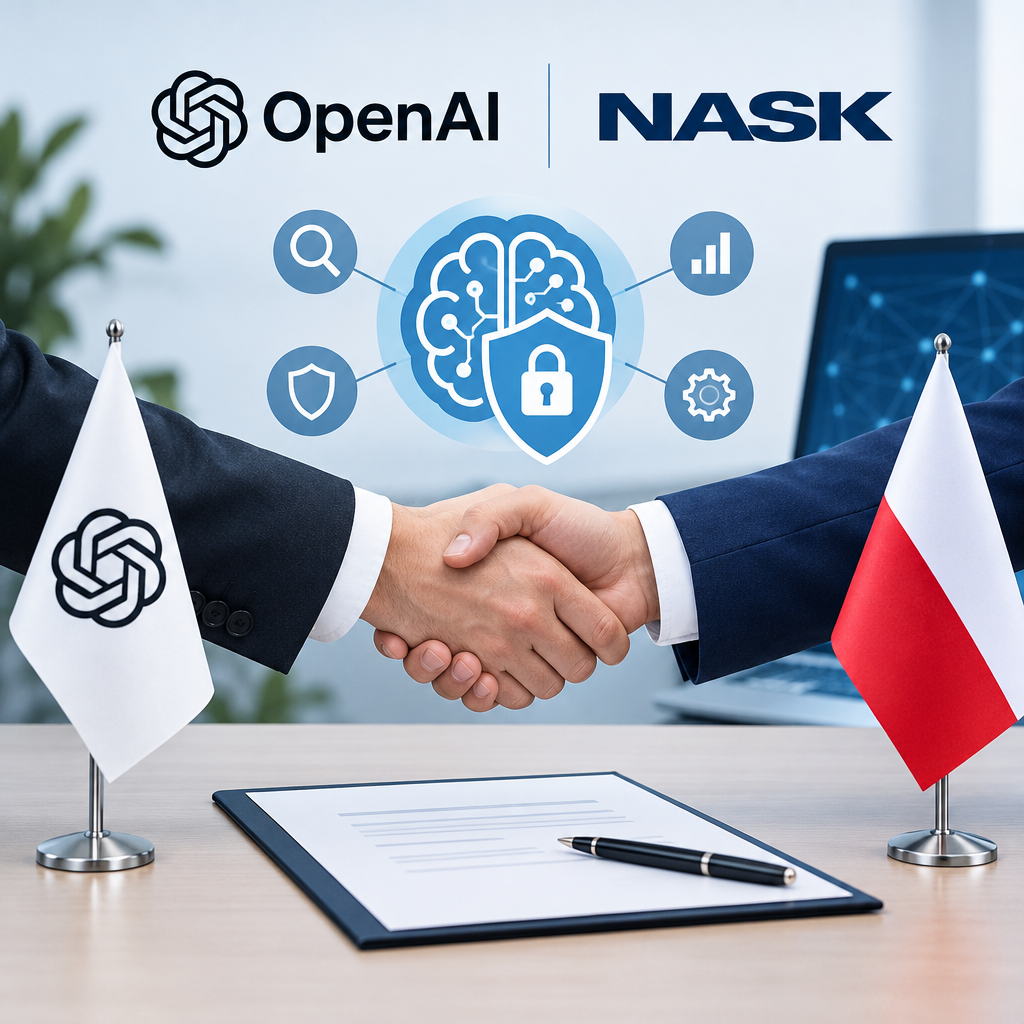
OpenAI and Poland's NASK National Research Institute signed an agreement to explore collaboration on AI safety, system security, and technical research. The parties intend to explore methods for evaluating increasingly capable AI systems, identifying potential vulnerabilities, and strengthening safeguards. NASK is participating through its AI Safety Research Center, which serves as Poland's AI Safety Institute.
Key facts
OpenAI and NASK signed an agreement to explore collaboration on AI safety, security, and technical research.
The agreement covers exploration of methods for evaluating AI systems, identifying potential vulnerabilities, and strengthening safeguards.
OpenAI said that in July CERT Polska, which operates within NASK, received access to its cyber-capable models through Daybreak and used them in finding six vulnerabilities in MikroTik RouterOS.
An objective look at what matters
The agreement does not introduce a new tool or a finished standard. It could help the parties compare risk-assessment methods and test results. For organisations, this points to the value of assessment procedures, incident records, and safeguard tests whose results can be compared across teams and countries.
Business processes
AI risk assessment and incident management — International collaboration may support more comparable approaches to safeguard testing and incident documentation.
Protection of public digital services — Research may help adapt AI evaluation methods to public digital systems, but no operational outcomes have yet been announced.
Automation opportunities
Collection and comparison of data for AI safety assessment: One possible approach is to standardise test logs, validation results, and incident records for analysis by different organisations. Conditions: The agreement describes exploration of collaboration rather than a shared platform already in operation.; Data-sharing, confidentiality, and accountability rules are needed.; Assessment metrics and procedures must be agreed by the parties.
Impact on manual work
The announcement provides no evidence of an implemented workflow or a measurable reduction in manual work. The prospective methods and outcomes of the collaboration have not been disclosed.
Limitations and risks
The agreement is to explore collaboration; no specific outcomes, timeline, or tools were announced.
OpenAI's statement about CERT Polska concerns an earlier episode and is not a result of the new agreement.