OpenAI’s Decisions API, Uber’s ChatGPT Work rollout, and the ForTy forest map
Issue date:
This issue covers OpenAI’s API for frequent in-app decisions, Uber’s newly started rollout of a workplace AI agent, and open geospatial data for tracking forest change.
This issue may include important events published earlier.
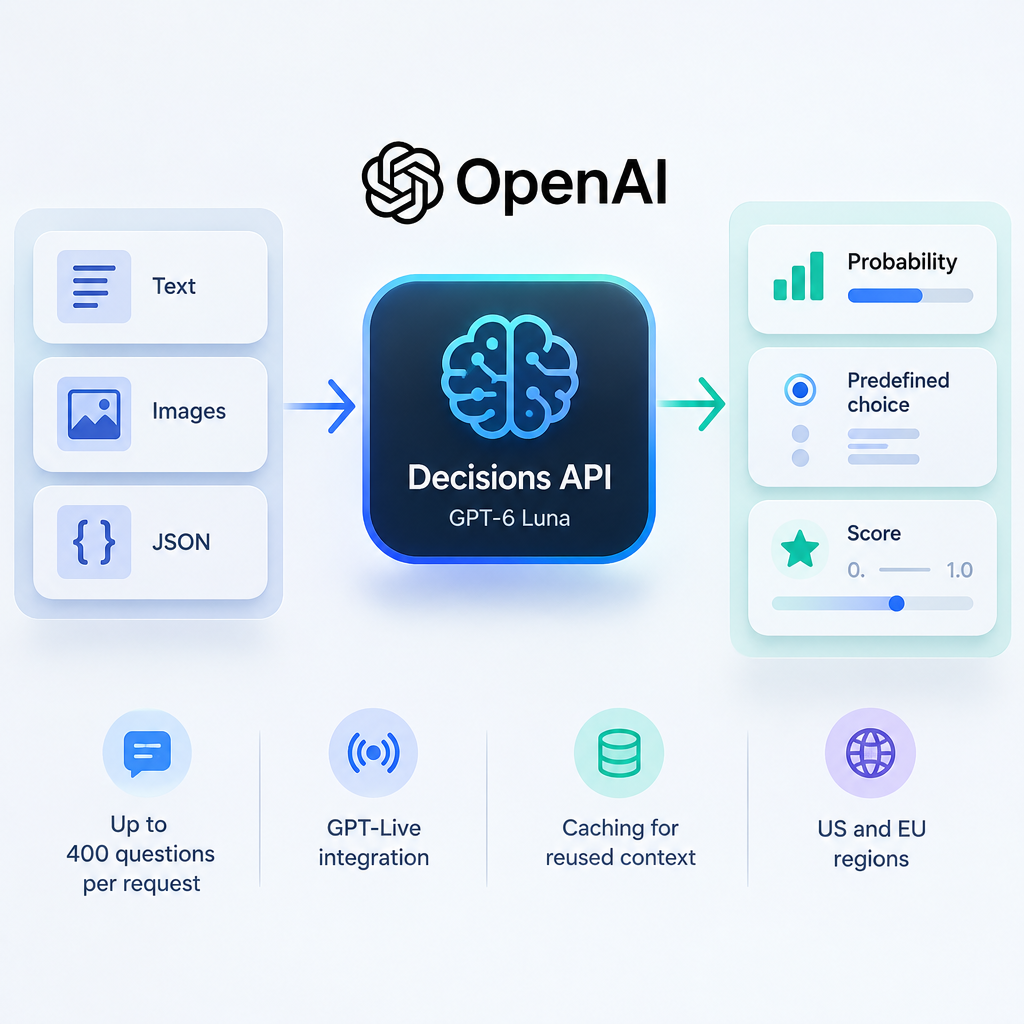
OpenAI announced general availability of Decisions API, built with GPT-6 Luna. It accepts text, images, and JSON, and returns a probability, one predefined choice, or a score. Developers can ask up to 400 questions per request. Since the public beta, OpenAI has added native GPT-Live integration, caching for reused context, and the option to process requests in the US and EU.
Key facts
Decisions API is generally available through a dedicated endpoint with GPT-6 Luna.
The API supports three response types: probability, predefined choice, and score.
OpenAI says the API can make bounded-answer decisions up to 10 times faster than GPT-6 Luna through the Responses API.
An objective look at what matters
Many workflows involve small, repeated decisions: classifying an incoming request, selecting a route, or choosing the next step. A dedicated API may simplify that part of an application or agent workflow. Developers still need to define allowed answers and test quality on examples from their own process.
Business processes
Customer support and request routing — Teams could select a clarifying question, queue, or handoff to an operator from a predefined set of options.
Incoming-data classification — Teams could assign transactions, messages, or documents to predefined categories.
Automation opportunities
Selecting the next action for a support agent: Send case context to Decisions API and use its choice to route, retry, or request clarification. Conditions: Allowed actions and handoff rules must be defined in advance.; Testing on real cases and error monitoring are needed.; Regional processing and data-retention requirements should be reviewed.
Live voice support: Use the GPT-Live integration to select the next action during a conversation. Conditions: An application using GPT-Live must handle decision.event messages.; Automated decisions need a safe path to a human operator.
Impact on manual work
The API may reduce manual triage and next-step selection in routine cases. The announcement provides no measured outcomes for such a deployment.
Limitations and risks
The API is intended for questions with bounded answers, not arbitrary decisions.
A probability, choice, or score does not replace rule checks or data-quality controls.
Pricing, caching terms, and availability should be checked against OpenAI’s current terms.
Zero Data Retention is available only to eligible customers.
Uber begins rolling out ChatGPT Work to more than 30,000 employees
Uber has begun rolling out ChatGPT Work to more than 30,000 employees worldwide after a 1,000-person pilot. The platform operates within ChatGPT Enterprise and connects to Google Drive, Gmail, Google Calendar, and Slack. OpenAI says employees can use it for information research, meeting briefs, presentations, data analysis, and tasks spanning applications.
Key facts
The rollout of ChatGPT Work to more than 30,000 Uber employees has begun, following a 1,000-person pilot.
ChatGPT Work connects with Google Drive, Gmail, Google Calendar, and Slack.
OpenAI describes this as Uber’s first company-wide deployment of an agentic platform tailored for knowledge work.
An objective look at what matters
This is an example of moving from a limited pilot toward company-wide access to an AI agent for knowledge work. Providing access is only part of the rollout: according to OpenAI, Uber is supporting it with an internal AI skills library, approved integrations, and employee training. Measured outcomes have not yet been published.
Business processes
Meeting preparation and enterprise information research — An agent could gather information from connected work systems and prepare a draft meeting brief.
Analysis and material preparation — Employees could use the agent to analyze data and draft presentations across work applications.
Automation opportunities
Preparing a meeting brief: Compile calendar, email, and file information into a draft for employee review. Conditions: Approved connections to enterprise systems are required.; Access rights and handling of confidential data must be configured.; A responsible employee should review the final material.
Multi-step knowledge-work tasks: Assign data gathering and first-draft preparation across work applications to an agent. Conditions: User training and rules for selecting suitable tasks are needed.; Quality controls and a clear error-correction process are needed.
Impact on manual work
The integrations may reduce manual research, context gathering, and first-draft preparation. Measured rollout results have not yet been published.
Limitations and risks
The rollout has only begun; its productivity effects are not confirmed by published data.
Agent access to email, files, and calendars requires permission management.
Complex multi-step outputs require human review.
Applicability depends on Uber’s approved integrations and internal training.
Google DeepMind and partners release the ForTy 2020 forest-type map
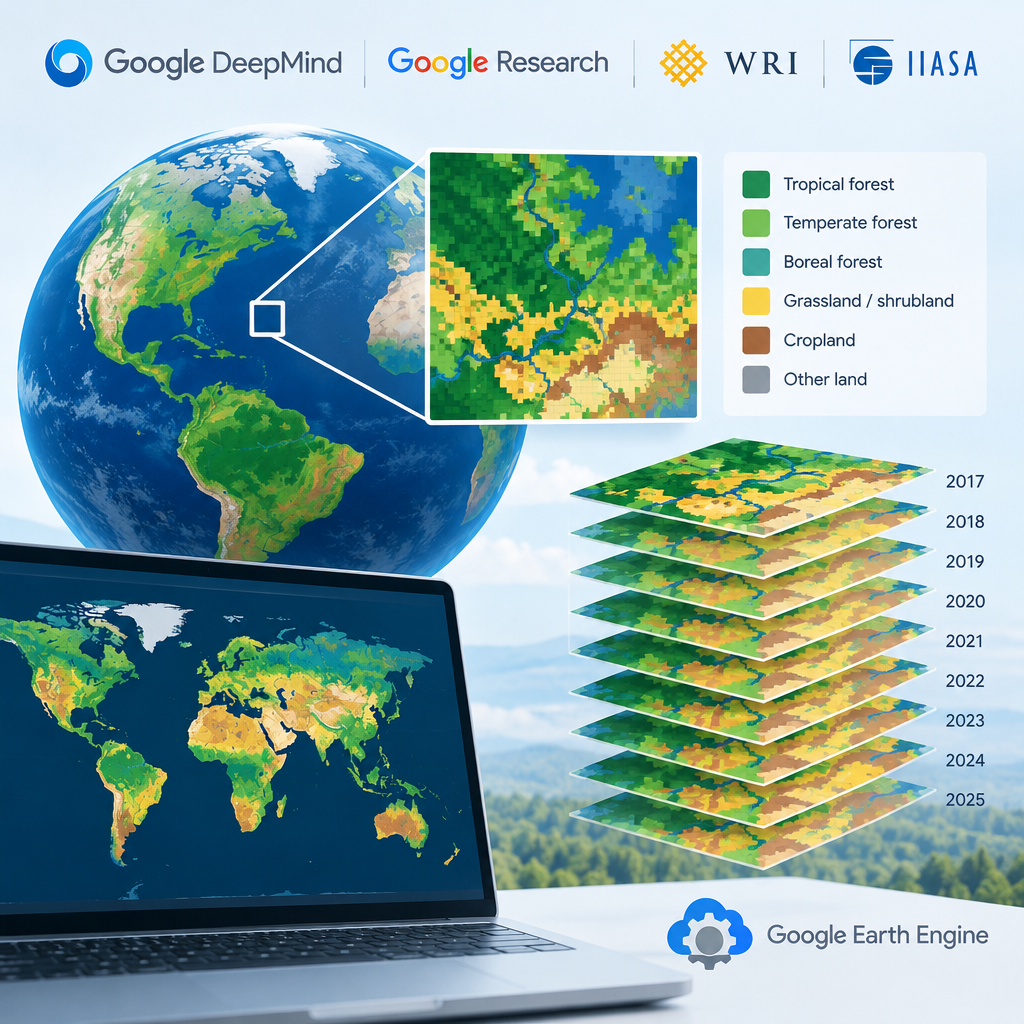
Google DeepMind, Google Research, WRI, and IIASA released ForTy 2020, a global map at 10-meter resolution. It assigns land patches to six forest and land-use categories. The release also includes an early time series for 2017–2025 showing annual changes, including the conversion of natural forest to plantations or farmland. The data are available in Google Earth Engine under an open license.
Key facts
ForTy 2020 classifies 10-by-10-meter land patches into six forest and land-use categories.
An early time series of changes from 2017 to 2025 has been released.
The developers report that, across more than 9,000 randomly selected validation sites, the map identified forest type correctly 90% of the time and distinguished forest from non-forest land 95% of the time.
An objective look at what matters
Tree cover alone is insufficient for deforestation monitoring: risk checks need to know the forest type and what replaced it. ForTy could support initial supply-chain risk assessment and audit prioritization, including work related to the EU deforestation regulation. But the map provides probabilities for each class, and the time series is an early release.
Business processes
Deforestation-risk checks in supply chains — Teams could compare supplier-site coordinates with forest types and land-use changes.
Environmental compliance and audit — Teams could direct manual review toward areas showing possible conversion of natural forest.
Automation opportunities
Initial screening of supplier-site locations: Automatically match coordinates against ForTy and flag potential forest conversion for further review. Conditions: Accurate coordinates, interpretation rules, and probability thresholds are required.; Map output should not be the sole basis for a compliance decision.; Applicable legal definitions and the relevant cutoff date must be considered.
Prioritizing environmental audits: Create an expert review queue from changes observed between 2017 and 2025. Conditions: The time series is an early release.; Satellite data and supplier information require further validation.
Impact on manual work
The data could automate initial screening of sites and reduce manual image review. Disputed areas and supporting documents would still need investigation.
Limitations and risks
The classification is probabilistic, so users must select thresholds for their use case.
The 2017–2025 time series is an early release.
The developers’ reported accuracy does not guarantee the same accuracy for a particular region or decision.
The map does not replace legal checks or documents verifying product origin.