Universal Cart in the US, COBOL migration tests, and Gemini Notebook plans
Issue date:
This issue covers Google’s shopping cart in Search and Gemini, OpenAI’s evaluations of coding in less widely represented programming languages, and a new step for preparing slides and videos in Gemini Notebook. Software can take on parts of each task, but people still need to check purchases, code migrations, and finished materials.
This issue may include important events published earlier.
Google begins US rollout of Universal Cart in Search and Gemini
Previously published event ·
Google has begun rolling out Universal Cart in the US across Search and the Gemini app. Shoppers can save products from different retailers in one cart, receive price-drop and back-in-stock alerts, and see relevant promo codes and payment-card benefits. Where a retailer supports it, a shopper can check out with Google Pay in Google’s cart or transfer items to the retailer’s cart and complete the purchase there.
Key facts
Google says saved products remain in the cart across its services. The cart can alert shoppers to price drops and items returning to stock.
According to Google, product information comes from its Shopping Graph of more than 60 billion continually refreshed listings. The cart can also display promo codes and card perks through Google Wallet.
Google names Nike, Sephora, Target, Ulta Beauty, Walmart, Wayfair, and many Shopify merchants as examples for trying simplified checkout; the available purchase path depends on the retailer.
Google says the merchant remains the seller of record and provides the shopper with order confirmations and customer support.
An objective look at what matters
A shared list and alerts may spare shoppers some manual checking of tabs, prices, and availability. For merchants, the cart provides another route to checkout through Google’s services without making Google the seller. Saving an item is not the same as placing an order or deciding that its terms suit the shopper.
Business processes
Online shopping and checkout — Shoppers can return to saved products and, where supported, pay in Google’s cart or move to the merchant’s site to finish the order.
Price and availability updates — Alerts may help shoppers notice a price change or restock without repeatedly searching for each product.
Automation opportunities
Collecting products across retailers and tracking them before purchase: The cart can retain items selected by the shopper and automatically surface price and stock changes, then display relevant offers when payment is considered. The purchase decision remains with the shopper. Conditions: The rollout has begun in the US; availability may vary for individual shoppers.; In-cart payment and item transfer depend on the merchant.; Shoppers still need to check the final price and purchase terms before ordering.
Impact on manual work
Alerts and a shared list may reduce manual product tracking. The source does not measure time saved; selecting items and a payment method and confirming a purchase remain shopper decisions.
Limitations and risks
The rollout was limited to the US and still under way when Google announced it.
Not every merchant supports checkout in Google’s cart; some purchases must be completed on a merchant site.
A promo code, alert, or card-perk suggestion does not replace checking the final price, delivery terms, and returns policy.
OpenAI publishes MultiLangBench and COBOL migration results
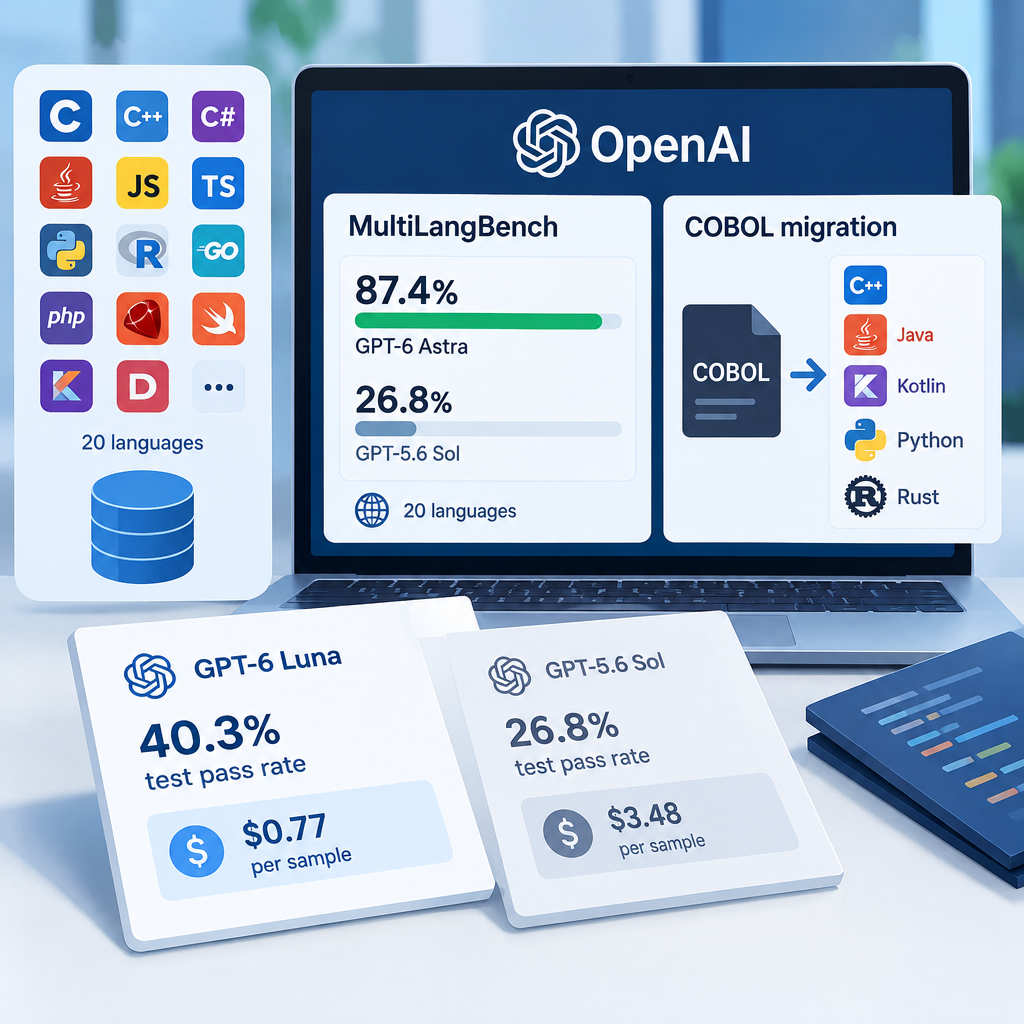
OpenAI has introduced MultiLangBench, which asks a model to build a SQLite-compatible database engine in one of 20 programming languages. It also published results from a separate evaluation of migrating COBOL programs to C++, Java, Kotlin, Python, or Rust while preserving their behavior. OpenAI has released the MultiLangBench setup and tests on GitHub; it does not say it has similarly released the migration evaluation.
Key facts
OpenAI reports that GPT‑6 Astra passed an average of 87.4% of MultiLangBench tests across 20 languages at maximum reasoning effort, versus 26.8% for GPT‑5.6 Sol. These are benchmark scores, not success rates for changes to production systems.
OpenAI reports an average test pass rate of 40.3% for GPT‑6 Luna at an estimated API cost of $0.77 per sample, versus $3.48 for GPT‑5.6 Sol—about 78% less.
In its COBOL migration evaluation, OpenAI reports 86.6% accuracy for GPT‑6.1 Sol at low reasoning effort, versus 5.4% for GPT‑5.6 Sol at the same setting. At higher effort, it reports 97.9% for GPT‑6.1 Sol.
OpenAI says a migration passes only if it clears all hidden tests requiring byte-for-byte parity of observable outputs; MultiLangBench instead measures test passes for the database engine being built.
An objective look at what matters
Older programs may contain calculation and record-handling rules that were never documented elsewhere. The results identify tasks teams might test on their own code; they are not approval to replace a working system automatically. MultiLangBench’s published materials let teams inspect that evaluation’s method. The separate migration scores remain OpenAI’s reported results.
Business processes
Legacy software maintenance — Teams can try models to analyze and prepare changes in COBOL, Fortran, Visual Basic, and other languages with less code and documentation available for model training.
Application migration — A model can draft a port, after which a team checks its behavior against the original program, business rules, and system dependencies.
Automation opportunities
Preparing and checking a COBOL program migration: A model could produce an initial translation and help revise it in response to tests. Checks of financial calculations, missing-record handling, and system integrations cannot be inferred from an OpenAI evaluation score alone. Conditions: OpenAI says its latest models can be tried on coding tasks through the API.; Production use requires tests for the particular system’s rules and dependencies, plus expert review.; MultiLangBench and migration scores do not guarantee that a production application will preserve its behavior.
Impact on manual work
A model may reduce manual drafting and initial code analysis. The source does not measure the work needed to validate real systems; specialists still need to check that behavior is preserved.
Limitations and risks
OpenAI published both sets of results for specific test tasks. Releasing MultiLangBench tests does not mean its migration evaluation is also open.
A rewrite can run without errors yet change financial results: COBOL may discard excess decimal digits where the new program rounds them.
Production use needs testing against the system’s own rules and dependencies, and review by specialists.
Gemini Notebook adds plan review before slides and videos are generated
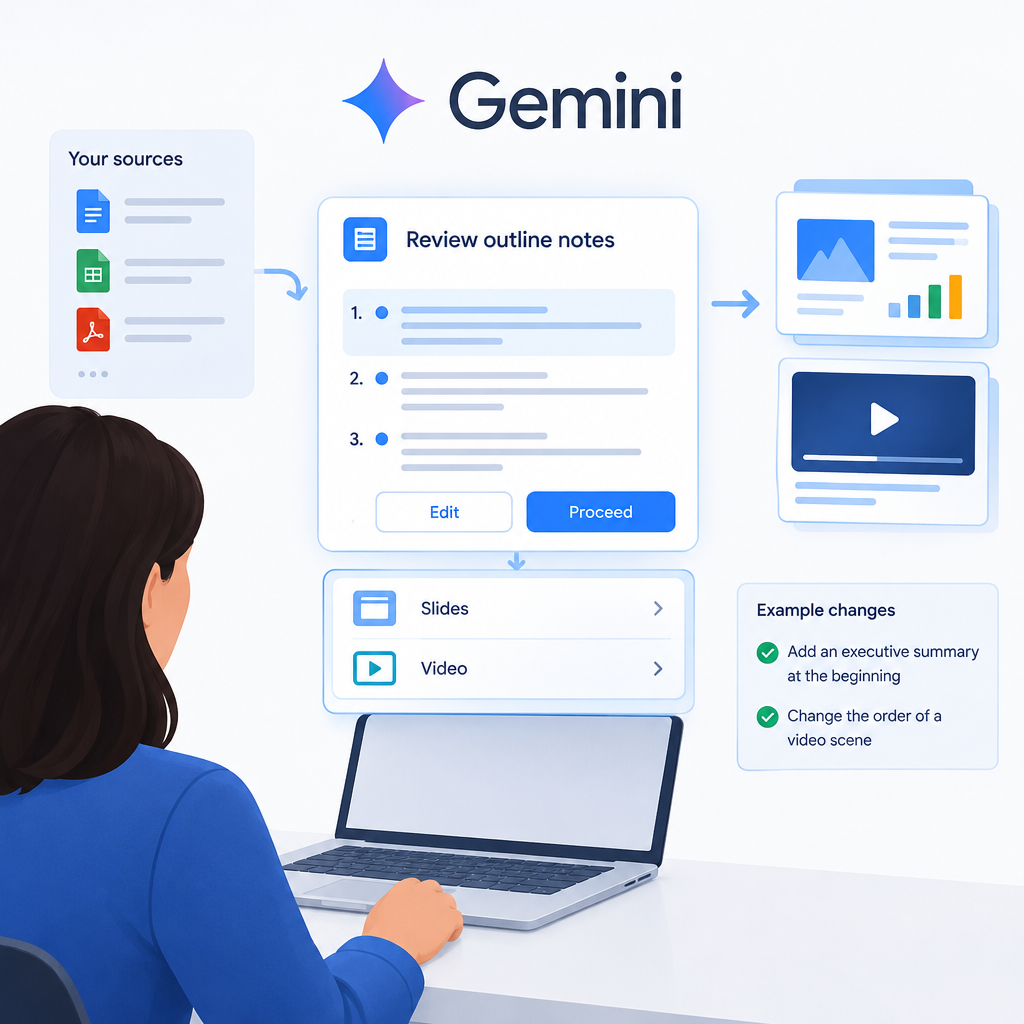
Google has added ways to shape a plan for Slide Decks and Video Overviews in Gemini Notebook before the final material is generated. The service suggests topics based on the user’s sources; users can confirm them and guide the content, visual style, and format. With Review enabled, they can inspect plan notes and give feedback before proceeding. Google says the features are rolling out globally over the week following its announcement.
Key facts
Google says users can open “Review outline notes” for slides or “Review producer notes” for video, give feedback, then select “Proceed” to generate the final material.
Google gives examples of changes made before generation: adding an executive summary at the beginning or changing the order of a video scene.
Review is optional. Google says users can still generate an artifact directly from the studio panel, or go straight to the review flow if their prompt already specifies what they want.
Google says these co-creation features are rolling out to all Gemini Notebook users globally over the coming week.
An objective look at what matters
Plan review moves discussion of structure to before finished slides or video are made. For teams that need agreement on topics, scene order, or style, this may reduce full rework. Approval of an outline does not establish that the eventual wording and visuals are accurate; the finished material still needs review.
Business processes
Presentation preparation — A team can agree on topics, section order, and visual requirements before generating slides from its sources.
Video overview production — An author can review video notes and change scene order or content requirements before generation.
Automation opportunities
Creating a presentation or video overview from source materials: Teams can insert a human review-and-feedback step before automatic generation. It provides a way to agree on direction, not an automatic guarantee of the finished material’s quality. Conditions: The features were still rolling out globally when Google announced them.; To use the approval step, a user must enable Review, inspect the plan, and proceed with generation.; Results depend on sources and instructions; the finished material still needs fact-checking and visual review.
Impact on manual work
Early agreement may reduce rework on finished materials, but the source provides no measurement of time saved. Plan review adds a human step and does not replace reviewing the output.
Limitations and risks
The rollout was still in progress when Google published its post, so access may not arrive for everyone at once.
Review can be skipped; the new step is not mandatory approval for every artifact.
An approved plan does not guarantee factual accuracy, faithful use of sources, or a finished design that meets a team’s requirements.