Atlassian agents, Google's local search model, and Claude access for cyber defense
Issue date:
This issue covers an agreement to use OpenAI models in Atlassian agents, Google's open model for searching text and media, and new Claude access tiers for vetted security professionals.
This issue may include important events published earlier.
Atlassian and OpenAI expand their AI agent agreement
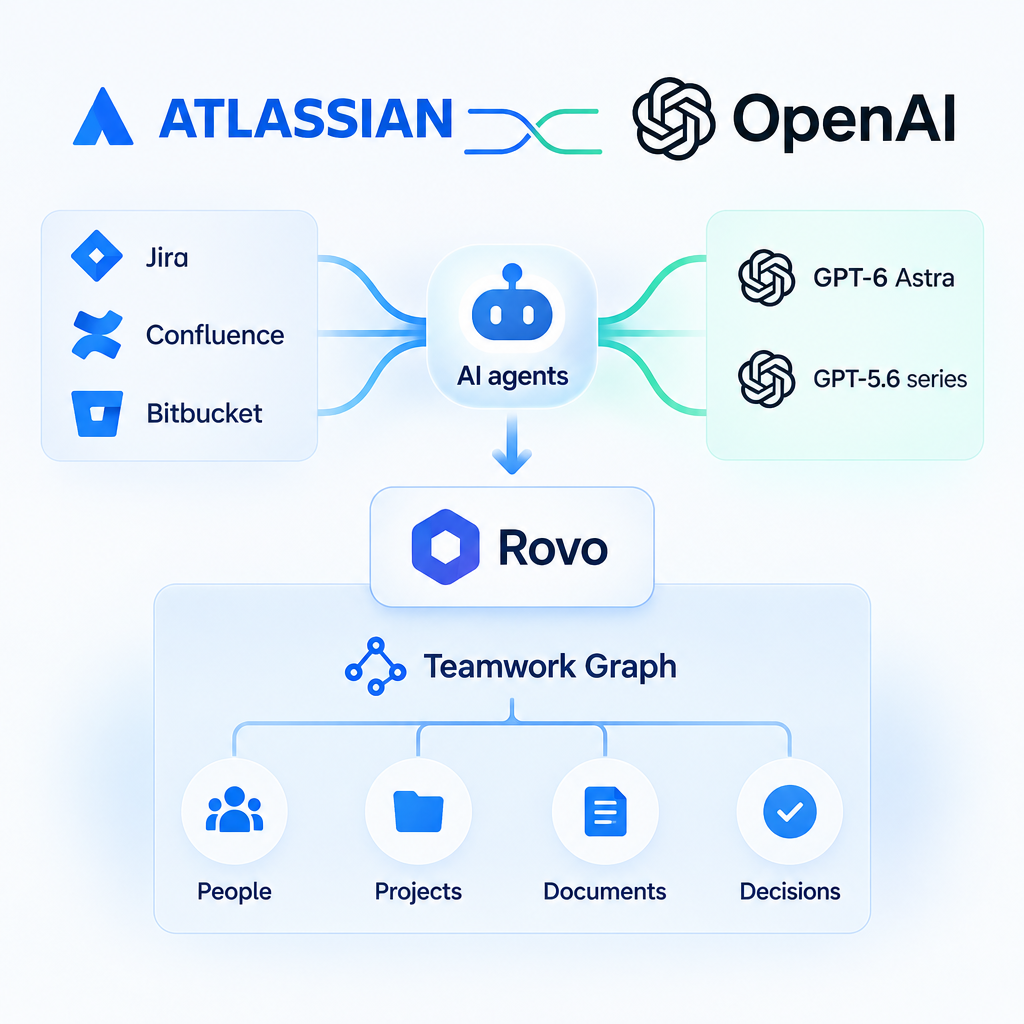
Under a new agreement, OpenAI models will power agents across Atlassian's platform and in Rovo. Rovo uses Teamwork Graph, an enterprise context layer connecting people, projects, documents, and decisions. Atlassian will also gain expanded access to OpenAI models, including GPT‑6 Astra and the GPT‑5.6 series. These are terms of an agreement, not an announcement that every proposed workflow is already live.
Key facts
OpenAI says its models will power agents across Atlassian's platform and Rovo.
Atlassian and Teamwork Graph plugins let users connect ChatGPT and Codex to work items, documentation, and development context, subject to permissions.
OpenAI says more than 3,000 Atlassian developers use Codex in terminals, development environments, and code review. This describes internal adoption, not a measured customer benefit.
The companies are exploring deeper Jira integration for assigning work to agents, tracking progress, recording decisions, and reviewing results.
An objective look at what matters
A useful work agent needs current context it is allowed to see, not just a chat interface. For a product launch, Rovo could draw on Jira tasks, Confluence documents, and discussions to prepare a readiness assessment. OpenAI presents this as an example of what the integration could do, not as a measured deployment result.
Business processes
Product launch preparation and deadline tracking — A summary of tasks and documents could highlight blockers and decisions needing attention. The launch owner would still need to check it against the underlying records.
Software development and code review — Plugins can make work items and technical documentation available as project context in ChatGPT and Codex, within applicable permissions.
Automation opportunities
Drafting launch status from Jira, Confluence, and discussions: An agent could bring deadlines, blockers, and open decisions into one draft instead of requiring staff to review several systems manually. This is a possible Rovo workflow, not demonstrated time savings. Conditions: Sources must be connected and access configured according to permissions.; An employee checks that the information and conclusions are current before acting.
Assigning and tracking AI-agent work in Jira: Eventually, teams might assign discrete tasks to agents, track completion, and review results within a Jira workflow. Conditions: Deeper Jira integration remains exploratory.; Teams would need rules for permitted actions, a designated reviewer, and a way to stop incorrect actions.
Impact on manual work
Reconciling tasks, documents, and discussions might take less manual effort. The source does not measure this effect for customers; outcomes depend on data completeness, permissions, and human review.
Limitations and risks
The account comes from a party to the agreement; it does not give release dates for every future capability.
Plugins must not grant an agent access beyond the user's permissions.
The launch-readiness example does not guarantee an accurate assessment of blockers or deadlines.
Assigning tasks to agents through deeper Jira integration should not yet be treated as an available feature.
Google releases the multimodal EmbeddingGemma 2 model
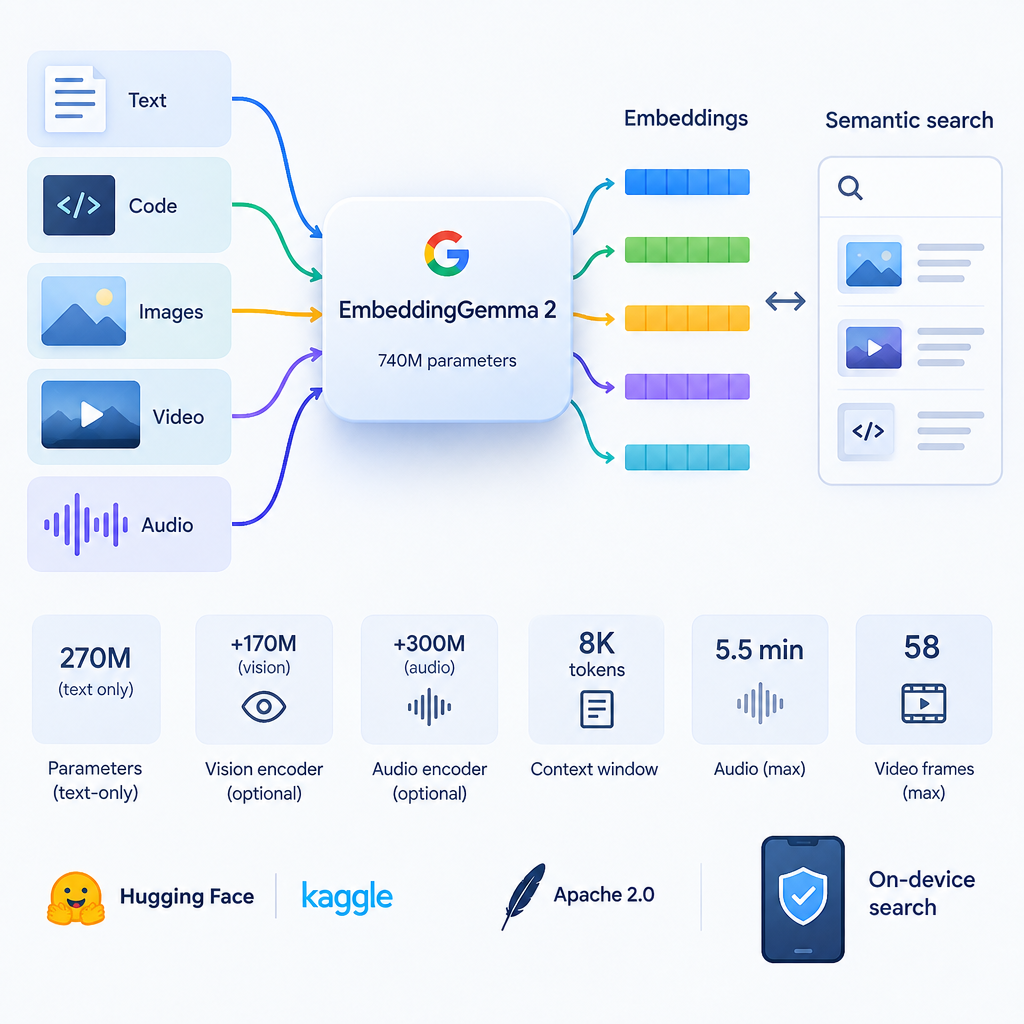
EmbeddingGemma 2 represents text, code, images, video, and audio in a shared space of numerical vectors, or embeddings, that can be compared for semantic search. Built on Gemma 4, the model has 740 million parameters and is released under Apache 2.0; its weights are available on Hugging Face and Kaggle. Google proposes using it, among other things, for on-device search without sending source materials to the cloud.
Key facts
For text-only workloads, Google says a 270-million-parameter component can be used; optional vision and audio encoders add 170 million and 300 million parameters respectively.
Google specifies an 8K-token context window and support for up to 5.5 minutes of audio or 58 video frames; actual input limits depend on the combination of materials.
According to Google, reducing vectors from 768 to 128 dimensions can cut local vector storage and memory requirements by up to six times. The effect on retrieval quality needs separate testing.
Weights are available to download; Google describes availability in Gemini Enterprise Agent Platform Model Garden as forthcoming.
An objective look at what matters
A shared embedding space allows a query in one format to find material in another: for example, a voice description could locate a video moment, or text could retrieve a recording. This model retrieves relevant material; it is not itself a generative question-answering model. Retrieved material can be passed to a separate generative model for an answer, an approach known as retrieval-augmented generation, or RAG.
Business processes
Searching documents, media libraries, and recordings — A local index could help staff find related materials by meaning, even when the query does not match file names.
Codebase search and context retrieval for developers — Code embeddings could help surface relevant snippets and documentation. Teams would need to assess retrieval quality on their own repositories.
Automation opportunities
Local multimodal search and retrieval for answer drafting: An application could index permitted materials on a device, retrieve relevant passages, and pass them to a generative model to draft an answer. Retrieval and generation remain separate steps. Conditions: Deployment requires an index, suitable hardware, and retrieval tests on the target data.; Access rules for source files must also apply to searches of their index.
Routing incoming materials by content: Embedding similarity could be one signal for classifying an item and choosing its next processing step. That is an application design option, not a ready-made decision rule. Conditions: Thresholds and false matches need testing against representative work items.; Critical decisions should not rest solely on vector similarity.
Impact on manual work
Finding files, code snippets, and recordings might require less manual browsing. Savings have not been shown for any particular organization and depend on the index, data, and queries.
Limitations and risks
Quality, memory, and storage figures come from Google. The two cited publications carry the same text, not independent evaluations.
On-device processing can avoid sending source materials to the cloud but does not itself enforce access controls on files or their index.
Google's memory figures concern a quantized model on a Pixel 11 Pro; other devices may have different requirements.
Shorter vectors save space but may change retrieval quality. Model Garden availability is still forthcoming.
Anthropic introduces three Cyber Verification Program access tiers
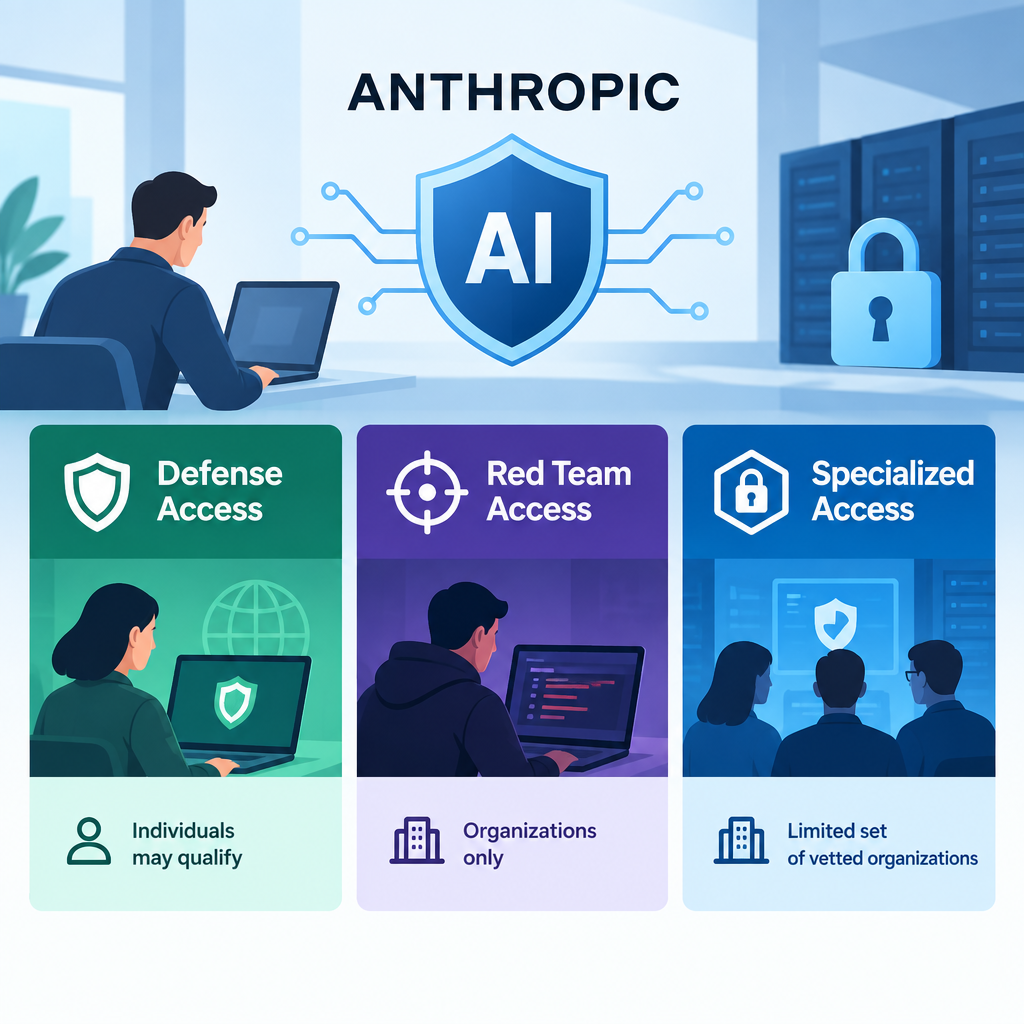
Anthropic announced an expanded Cyber Verification Program that brings it together with Project Glasswing. The program now has Defense Access for defensive work, Red Team Access for authorized penetration testing, and Specialized Access for a limited set of vetted organizations working with particularly sensitive systems. The tiers differ in applicant vetting, security controls, and the extent to which Claude's cyber safeguards are reduced.
Key facts
Applicants may request a tier suited to their work, but access depends on vetting and required security controls. Generally available models retain more conservative cyber safeguards.
Red Team Access is currently for organizations only and permits testing solely against systems they are authorized to test. Individual researchers may qualify for Defense Access, but not this tier.
Specialized Access is reserved for a limited group of vetted organizations; Anthropic says it reviews these organizations in depth in collaboration with the US government.
Anthropic reports that, in its CyScenarioBench test of Claude Opus 5.5, safeguards blocked 46 of 50 attempts at some point in Defense Access. Red Team Access had no blocks, and the model completed 34 of 50 attempts.
An objective look at what matters
A tool that helps defenders find a vulnerability can also help attackers exploit it. The program offers vetted teams a route to stronger capabilities for defense and authorized testing without giving everyone the same access. The benchmark results show how restrictions differed under Anthropic's test conditions; they do not establish that every real-world use will be safe.
Business processes
Security monitoring and incident response — A team could use its approved access tier to review alerts, analyze malware, and assess vulnerabilities in systems it defends.
Vulnerability assessment and penetration testing — Defense Access covers defensive analysis; Red Team Access adds adversarial methods only within the organization's authorization and program rules.
Automation opportunities
Alert triage and vulnerability analysis in owned code: A model could help group signals, investigate a possible issue, and prepare information for an analyst. Generally available models with existing safeguards can also handle some of these tasks. Conditions: Expanded access requires applicant verification and compliance with the chosen tier's rules.; An analyst checks findings and decides which actions, if any, to take.
Stages of authorized penetration testing: With Red Team Access, a model could assist with parts of a test when the organization has permission to test the specific system. This does not authorize activity outside the agreed scope. Conditions: Only organizations can obtain this tier, following vetting.; Real-time blocks remain for actions that risk physical harm or mass disruption.
Impact on manual work
Assistance with analysis might speed up individual tasks, but the published tests measure cyber-task performance and safeguards, not labor savings for a particular team. People retain responsibility for decisions and testing authorization.
Limitations and risks
Access is not automatic: applicants need vetting and required controls, and administrators must assign access to workspaces.
Data retention is required for organizations in the program to monitor misuse. Until Enterprise Frontier Safeguards is available, Anthropic specifies exceptions for those with existing zero-data-retention access to Claude Fable 5.1 or Claude Mythos 5.1.
Enterprise Frontier Safeguards is described as forthcoming for eligible organizations; Cyber Verification Program access through Amazon Bedrock is restricted to customers eligible for it.
Red Team Access still blocks dangerous actions, while Specialized Access is restricted to a limited set of organizations.
The CyScenarioBench figures are Anthropic's own evaluation; the source does not provide independent verification.