OpenAI text watermarking, ChatGPT visual ads and Google educator training
Issue date:
This issue covers opt-in text watermarking in OpenAI’s API, a forthcoming visual ad test in ChatGPT and the expansion of Google’s educator training program.
This issue may include important events published earlier.
OpenAI opens optional text watermarking for API customers
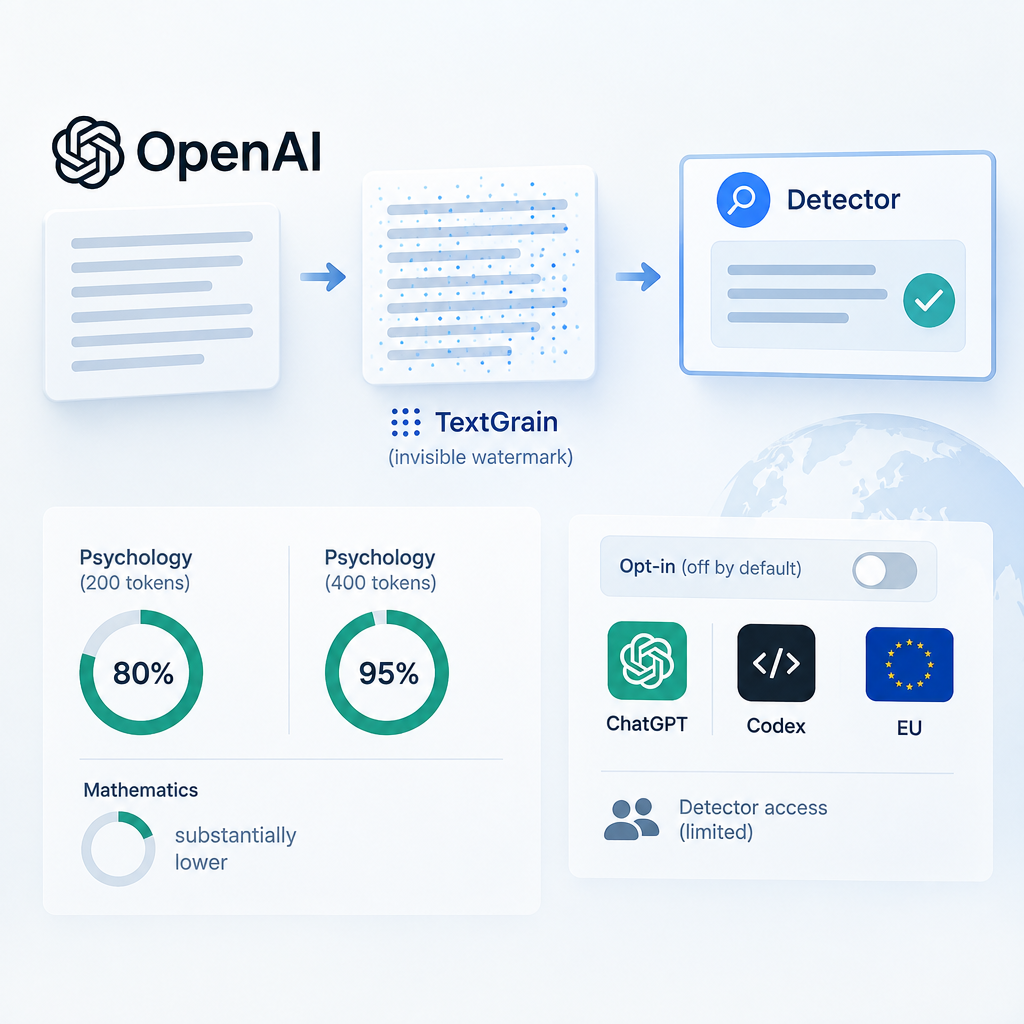
OpenAI API customers worldwide can now opt in to textGrain watermarks for text from select models. The feature is off by default. In the coming weeks, the company plans to watermark eligible ChatGPT and Codex text output in the EU. Applications for detector access are open, but initial access is limited to approved researchers and expert organizations.
Key facts
textGrain adds an invisible statistical signal to a model’s word choices; OpenAI’s detector looks for that signal in text.
According to OpenAI, at a target false-positive rate of 1%, its detector found watermarks in about 80% of 200-token passages and 95% of 400-token passages for content such as psychology. Results were substantially lower for mathematics.
OpenAI reports that, in a separate evaluation of 400-token passages, replacing 10% of words with synonyms reduced detection from about 92% to 66%; replacing 25% reduced it to 17%.
An objective look at what matters
Organizations can choose to add a provenance signal to text generated through eligible API models. It may help with transparency procedures, but it cannot show how much work a human contributed or establish authorship, lawful use or accuracy. A failure to detect a watermark does not prove that a person wrote the text.
Business processes
Text creation through an API — Teams can enable watermarking for eligible model outputs in workflows where indicating AI involvement matters.
Content-provenance review — A detector result may be one signal for a specialist, not stand-alone proof of a text’s origin.
Automation opportunities
Generating drafts, descriptions and responses through an API: Enable textGrain for supported models and record in the organization’s workflow whether an output was watermarked. Conditions: Watermarking is available for select API models and is off by default.; Recording its use is a possible organizational measure, not a stated textGrain feature.; Watermarking does not replace applicable disclosure practices or human review.
Reviewing disputed text materials: If access is granted, use the detector as an additional signal in a review process. Conditions: Initial access by application is limited to approved researchers and expert organizations.; Short, edited or translated text may not yield a reliable result.
Impact on manual work
Watermarking may help with an initial provenance check. Specialists will still have to interpret detector results and make content decisions; no reduction in work has been demonstrated.
Limitations and risks
The detector can falsely report a watermark or miss one that is present.
Editing and limited flexibility in word choice make detection harder.
ChatGPT and Codex watermarking is only planned for eligible text output in the EU; it is not a global default.
Detection does not identify the user or establish responsibility or text accuracy.
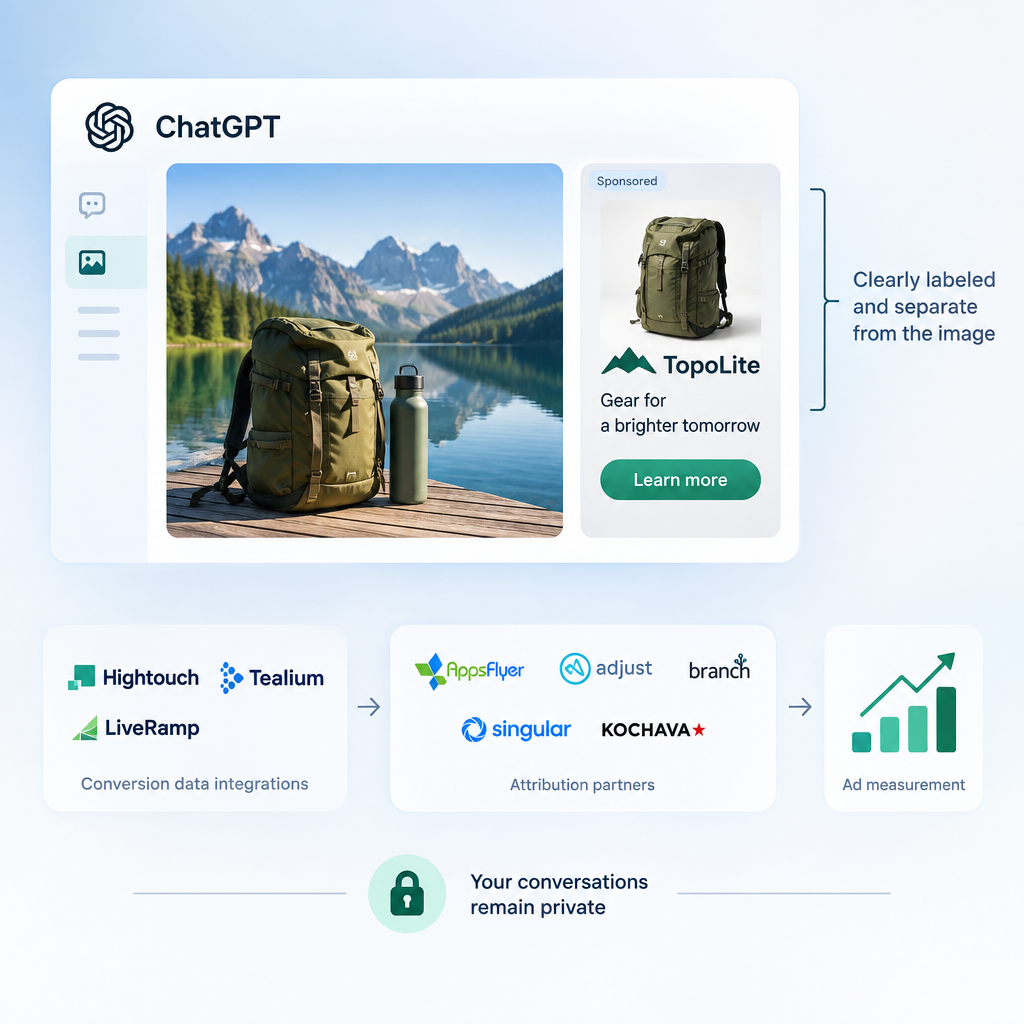
OpenAI introduced a visual ad format for ChatGPT. It plans to begin testing later in October with an initial group of US advertisers during image generation. Ads will be clearly labeled and separate from the image being created. OpenAI also expanded tools and partnerships for sharing conversion data, attribution and ad measurement.
Key facts
OpenAI says advertising does not influence ChatGPT’s answers and that user conversations remain private.
OpenAI named Hightouch, Tealium and LiveRamp integrations for sending conversion data, along with attribution partners including AppsFlyer, Adjust, Branch, Singular and Kochava.
OpenAI says it is exploring geographic experiments with Haus, Measured and WorkMagic to assess ads’ incremental impact. That work is at an early stage.
An objective look at what matters
Advertising teams have more ways to connect ChatGPT Ads with their existing measurement systems. The visual format’s performance cannot be judged from its introduction: testing has not started. OpenAI is also developing pilots with DoubleVerify and Integral Ad Science to independently assess how its rules for suitable ad placements are applied, without giving those partners access to private conversations.
Business processes
Advertising performance measurement — Supported integrations can send conversion data from existing systems for comparison with campaign reporting.
Advertising placement control — OpenAI describes rules for excluding unsuitable contexts. Negative Phrases, a feature for brand-specific requirements, is available only to qualifying advertisers.
Automation opportunities
Sending conversions to advertising analytics: Set up conversion-data sharing from existing systems to ChatGPT Ads through a supported integration. Conditions: A suitable integration or partner solution is required.; Teams should check data quality, applicable consent rules and internal requirements.
Testing visual ads in ChatGPT: If admitted to the test, evaluate the new format separately from existing campaigns. Conditions: Testing is planned for later in October, initially in the US with a limited group of advertisers.; Results from individual early campaigns should not be generalized without independent validation.
Impact on manual work
Integrations may reduce manual conversion-data transfers. Specialists will still need to set up measurement, assess incremental impact and review placement suitability; time savings have not been measured.
Limitations and risks
The announced visual-format test has not begun, and the format is not presented as broadly available.
Work on measuring ads’ incremental impact is at an early stage.
Published results from individual partners do not predict results for other campaigns.
Negative Phrases is limited to qualifying advertisers; independent placement assessment is still being developed through pilots.
Google expands AI training for UK and Ireland educators
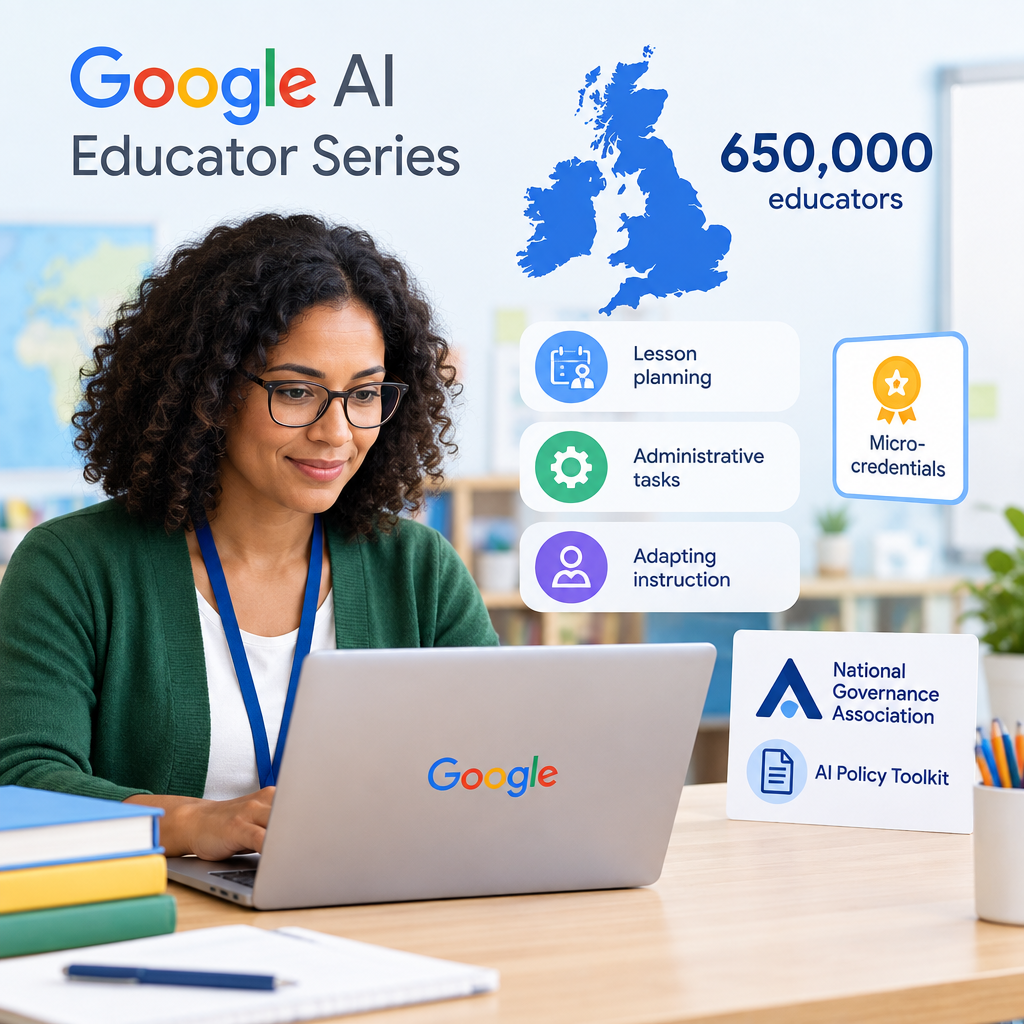
Google expanded its free Google AI Educator Series to 650,000 educators in the UK and Ireland. Educators lead virtual and in-person events; participants can earn micro-credentials and badges for completing modules. Google also announced a partnership with the National Governance Association to create an AI Policy Toolkit for schools.
Key facts
The program covers responsible AI use for lesson planning, simplifying administrative tasks and tailoring lessons to different learning needs.
Google says the program was previously launched for 6 million US educators and later expanded to India and Korea. That figure describes the intended reach, not the number who completed training.
Google cites Public First analysis finding that AI could potentially enhance 74% of education roles in the UK.
An objective look at what matters
The expansion gives educators a way to learn how AI might help with specific tasks; it does not mean schools have deployed those tools. School leaders still need to decide which materials and data may be used, how outputs will be checked and who is accountable for decisions.
Business processes
Preparing learning materials — Educators can learn to draft and adapt lesson plans with AI while retaining responsibility for reviewing the material.
School AI-use policy — The toolkit being developed with the National Governance Association may help school governors and trustees plan their approach to tools and training.
Automation opportunities
Preparing lesson plans and administrative materials: After training, try AI for drafting and adapting materials, subject to educator review. Conditions: The program teaches AI use but does not demonstrate automation of school tasks.; Schools need their own rules for safe use and material review.
Staff professional development: Include program events in educator training plans. Conditions: Google presents the program as free for educators in the UK and Ireland.; Teacher-led virtual and in-person events are part of the program.
Impact on manual work
The skills taught may help reduce time spent on some preparatory and administrative tasks. Google provides no measurements of realized time savings in schools.
Limitations and risks
Training is not deployment: outcomes depend on applying the skills, school policies and material review.
The 74% potential figure, cited by Google from Public First, does not measure this program’s impact.
The program does not remove educators’ responsibility for content and safe tool use.