Barclays expands its use of Claude in banking operations
Previously published event ·
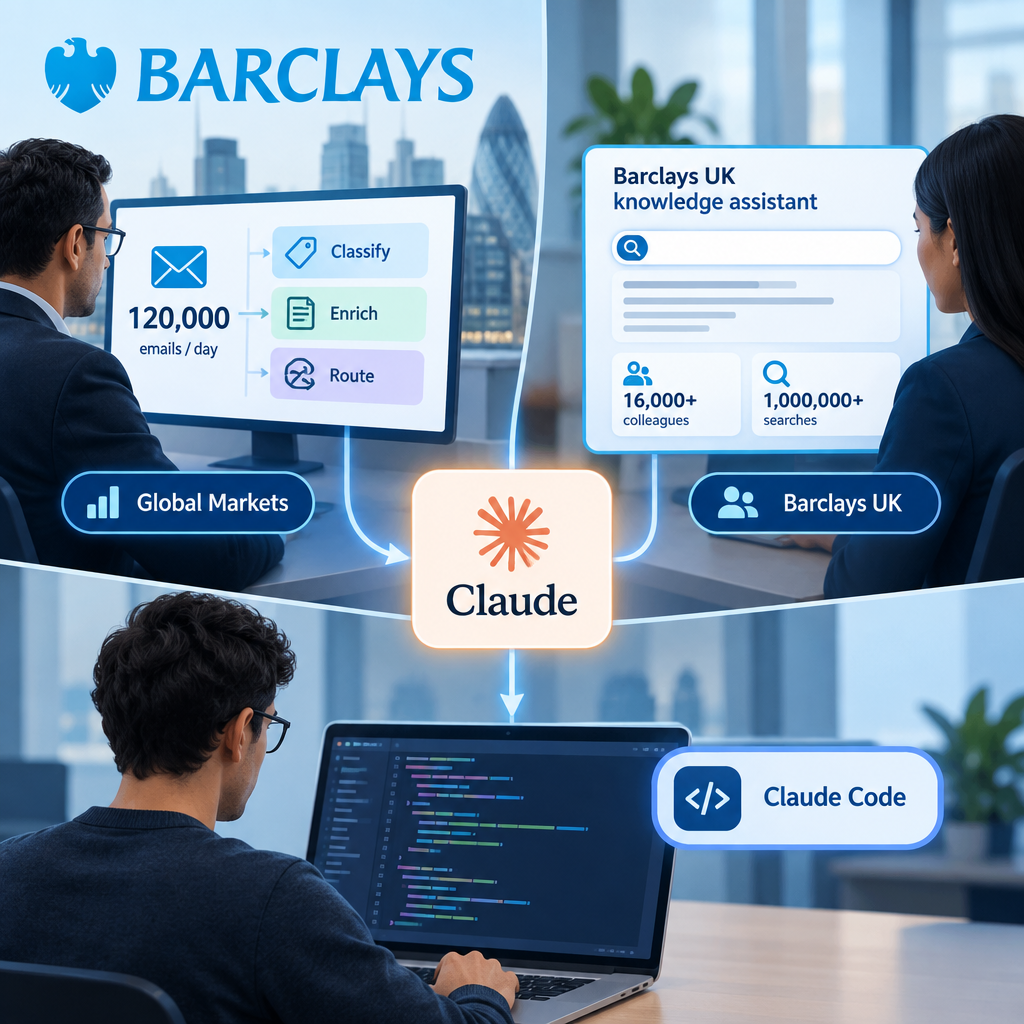
According to Anthropic, Barclays is expanding Claude’s use in software development, legacy-system modernization, and operations. Its Colleague Knowledge Assistant has been live since 2025, helping Barclays UK employees find information while serving customers. In Global Markets, Claude models classify incoming emails, add information, and help determine how they should be routed. Anthropic presents these as parts of an expanding partnership, not as fully automated customer service.
Key facts
Anthropic says more than 16,000 Barclays employees have adopted the knowledge assistant and that it has handled over one million searches.
Anthropic says the Global Markets email platform processes approximately 120,000 emails a day. Models help classify inquiries, enrich the information, and determine a route so operations staff can take action.
According to Anthropic, Barclays expects Claude Code adoption to reach 50% of its developers by the end of 2026 and a majority of software engineers in 2027. These are targets, not achieved adoption figures.
Why it matters
The language model does more here than retrieve answers: it helps prepare a stream of client emails for an operations team. Classification quality, complete information, and a clear handoff to staff matter in this setting. The figures and claim of reduced manual handling come from the model supplier, Anthropic; its publication offers no independent measure of time saved.
Business processes
Handling incoming Global Markets emails — Classification, information enrichment, and routing can help staff prioritize an inquiry and see whether it contains what they need to proceed.
Finding information while serving customers — An assistant drawing on internal material may help employees find an answer sooner. The publication does not independently measure changes in service time.
Software development and maintenance — Barclays plans broader Claude Code adoption and uses Claude in modernization work; future developer reach does not establish an improvement in engineering speed or quality.
Automation opportunities
Preparing and routing incoming emails: A model could suggest a category and destination, identify missing information, and send uncertain cases to staff. This is partial automation, not a reason to remove review of consequential inquiries. Conditions: Email access rules, decision logs, and checks of classification quality on operational data are needed.; The bank must define which inquiries need staff decisions and how incorrect routing is corrected.
Knowledge retrieval for support staff: An assistant could retrieve relevant knowledge-base material to help an employee find an answer. Before using that answer with a customer, the employee should check it against current bank guidance. Conditions: The knowledge base must be current, with access limited to material the employee is authorized to use.; A way to identify incorrect or outdated answers is needed.
Impact on manual work
Anthropic says its email use case reduces manual handling. The publication supplies no independent measurement of time saved or effect on staffing.
Limitations and risks
Anthropic says Barclays applies security controls, AI governance, and human oversight, but gives little detail on how individual decisions are checked.
A wrong category, missing information, or incorrect route could delay a customer response; email volume alone says nothing about processing accuracy.
Claude Code adoption targets for 2026–2027 must not be treated as results already achieved.
Anthropic launches Claude Frontier Academy for engineers
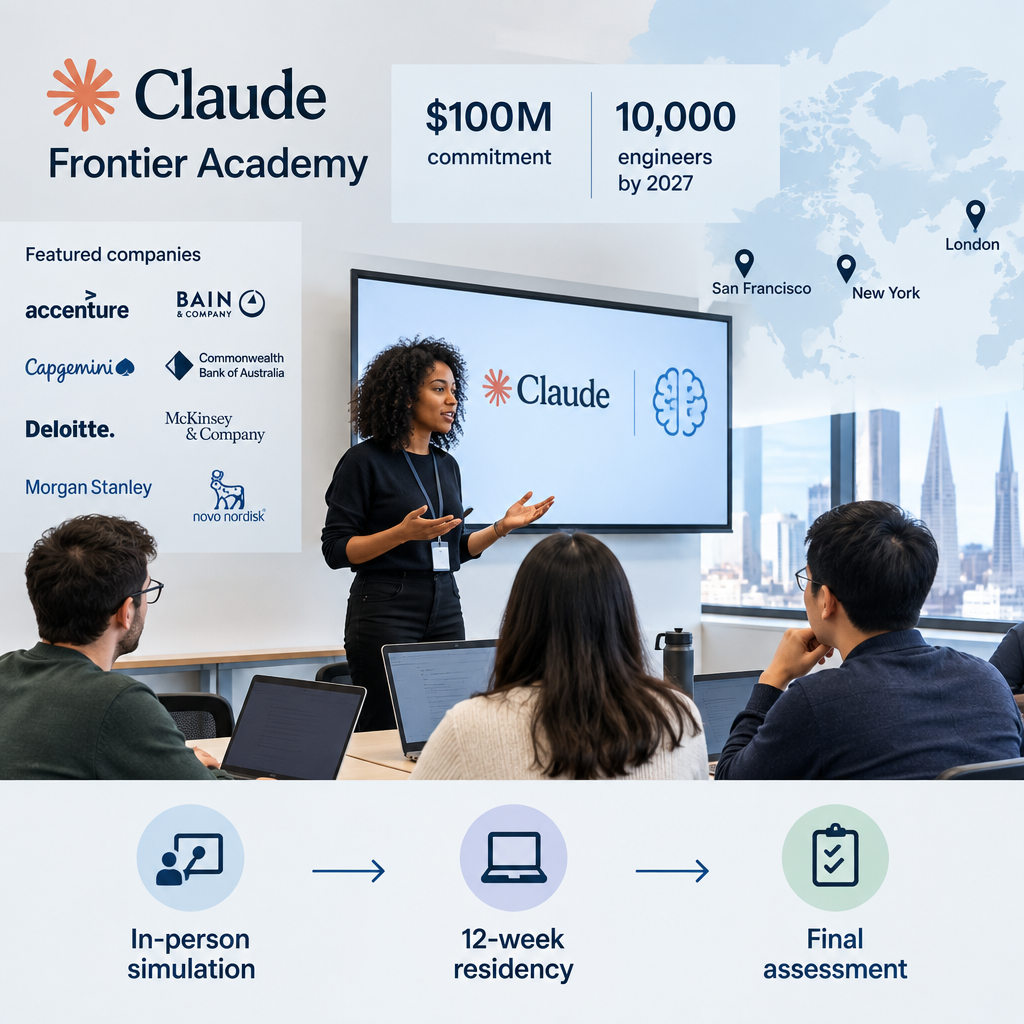
Anthropic has started the first Claude Frontier Academy cohorts in San Francisco, New York, and London. The program trains engineers to lead Claude projects within their organizations. It begins with an in-person simulation of an enterprise deployment and a practical assessment. Participants who pass move into a 12-week residency, working on a real project at their own organization with support from Anthropic engineers. A separate assessment follows that residency.
Key facts
Anthropic announced a $100 million commitment to the program and a goal of training 10,000 engineers by the end of 2027. These figures describe a commitment and a target, not money already spent or graduates already trained.
Anthropic says the first cohorts are running and include engineers from Accenture, Bain, Capgemini, Commonwealth Bank of Australia, Deloitte, McKinsey, Morgan Stanley, and Novo Nordisk.
Organizations nominate candidates with a specific Claude project. The first participants to earn the final Claude Frontier Deployed Engineer badge are expected in early 2027.
Why it matters
The program focuses on people expected to take an AI use case through security review and into operation. In the training simulation, engineers work through those steps before starting a project at their own organization. That approach may help teams establish a more consistent deployment practice. Launching the training does not, however, demonstrate outcomes from future projects or guarantee that the enrollment target will be met.
Business processes
Preparing enterprise AI projects — Participants can practice choosing a use case, building a solution, and handing it over, then apply what they learn to their own Claude project.
Reviewing solutions before deployment — The simulated deployment includes security review. An organization still needs its own assessment of risks and data-use requirements for a real project.
Automation opportunities
Building an internal AI deployment team: An organization could nominate an engineer with a defined project and later assess whether Claude can automate selected steps in its workflow. The program develops people; it does not provide a ready-made automated process. Conditions: Organizations nominate participants and must check eligibility with Anthropic or a partner account manager.; Candidates need software-engineering fundamentals, experience with large language models, and a named Claude project; prior AI-agent development is not required.; The resulting project still needs the organization’s security, quality, and policy checks.
Impact on manual work
There is no measured reduction in manual work from the training program itself. Graduates may later build solutions that change particular tasks, depending on their project outcomes.
Limitations and risks
The first cohorts are under way, but training 10,000 engineers by the end of 2027 remains Anthropic’s stated goal.
The first final badges are not expected until early 2027; passing the introductory stage is not the same as completing the residency.
Claude-focused training does not replace an employer’s own solution reviews, data-access controls, or security requirements.
Google launches spoken visual assistance in Gemini Live
Previously published event ·
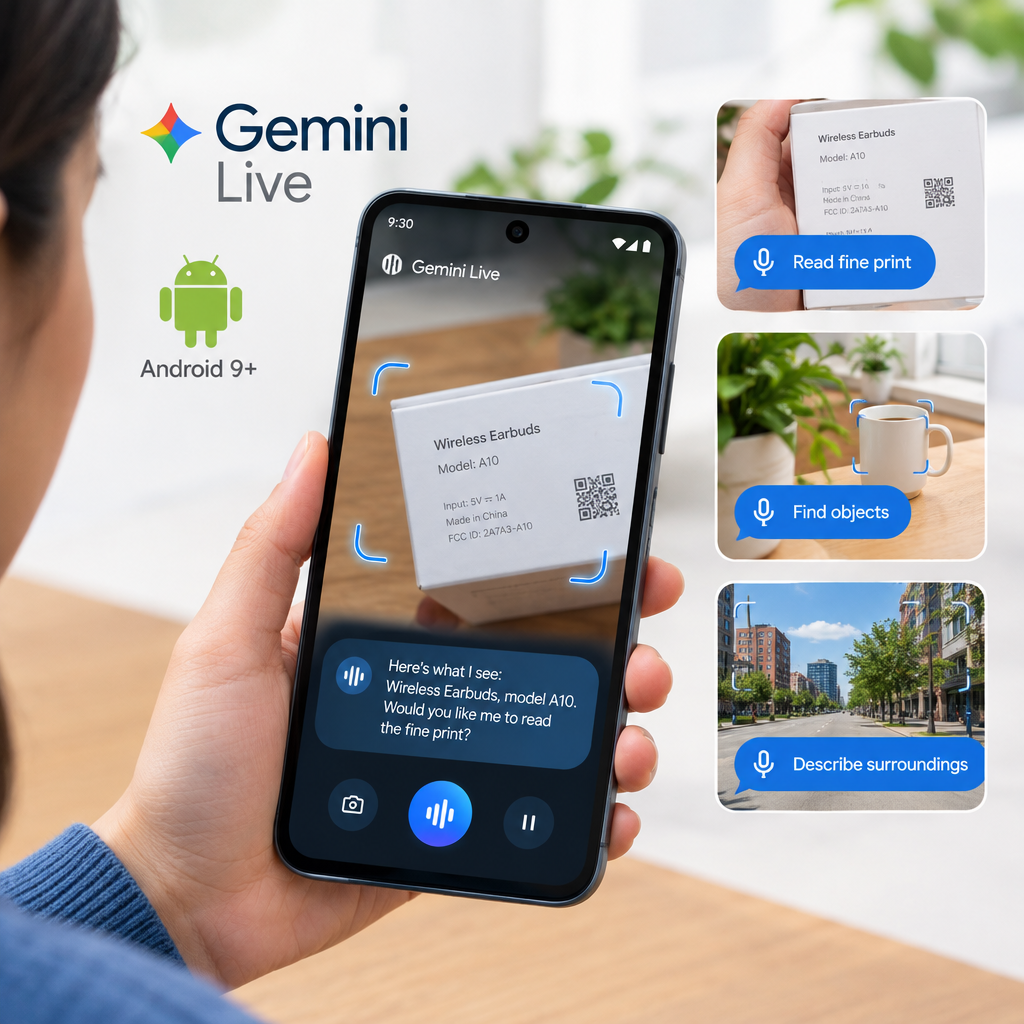
Google has launched Guided Vision for Gemini Live on compatible Android devices. Once a user turns it on and shares their camera, it describes what is visible aloud, answers follow-up questions, and suggests how to reframe the camera for a clearer view. Google designed it primarily for people who are blind or have low vision, while also describing everyday uses for others, such as reading fine print, finding an object, or describing its color.
Key facts
Google describes Guided Vision as providing spoken camera-based descriptions, answering follow-up questions, and prompting users to reposition their camera.
Google says the feature is available on compatible Android 9-or-later devices where Gemini Live supports the user’s region and language; the Gemini app and system software should be updated.
Google warns that Guided Vision can make mistakes, is not a medical device or mobility aid, and is not intended for navigation, safe-travel guidance, or obstacle detection.
Why it matters
Conversational descriptions may help when someone needs to understand visible text or an object quickly. Spoken camera-positioning prompts are especially useful when the person cannot readily check the image themselves. For an organization, this illustrates how accessible mobile tools might support specific work tasks. The publication does not describe an enterprise integration or measure accuracy in those workplace scenarios.
Business processes
Accessibility of everyday work tools — In suitable settings, an employee may ask for a spoken description of a label or object. This could assist a person but does not replace accessibility requirements for the service itself.
Simple mobile visual checks — The feature may help read small print or locate an object when a mistaken answer would not create a health or safety risk.
Automation opportunities
Spoken assistance with low-risk visual tasks: A user can show the camera an object or text, hear a description, and ask a follow-up question. This assists with a discrete task; it does not verify that the answer is correct. Conditions: A compatible device running Android 9 or later, updated software, and Gemini Live support in the user’s region and language are required.; Important details should be checked another way. The feature must not be used for navigation, obstacle detection, or safe travel.
Impact on manual work
Users might need another person’s help less often for some low-risk visual checks. Google provides no measurement of such an effect.
Limitations and risks
The generative system may misdescribe an object, text, or surroundings; its response is not a guaranteed verification.
Guided Vision does not replace a white cane or other established mobility aids, is not a medical device, and is not intended for physical-safety tasks.
Availability depends on a compatible Android device and Gemini Live support for the relevant region and language.