GPT-6 Sol and Luna, Claude Opus 5.5, and AI tools for farmers
Issue date:
This issue covers two model releases for multi-step work and an initiative to apply AI in agriculture. OpenAI introduced GPT-6 Sol and Luna alongside tools for managing cached, reusable context. Anthropic released Claude Opus 5.5 with new pricing and safeguards. Google and the Gates Foundation announced funding for climate, crop, and language tools intended for smallholder farmers.
This issue may include important events published earlier.
OpenAI releases GPT-6 Sol and Luna and updates prompt caching
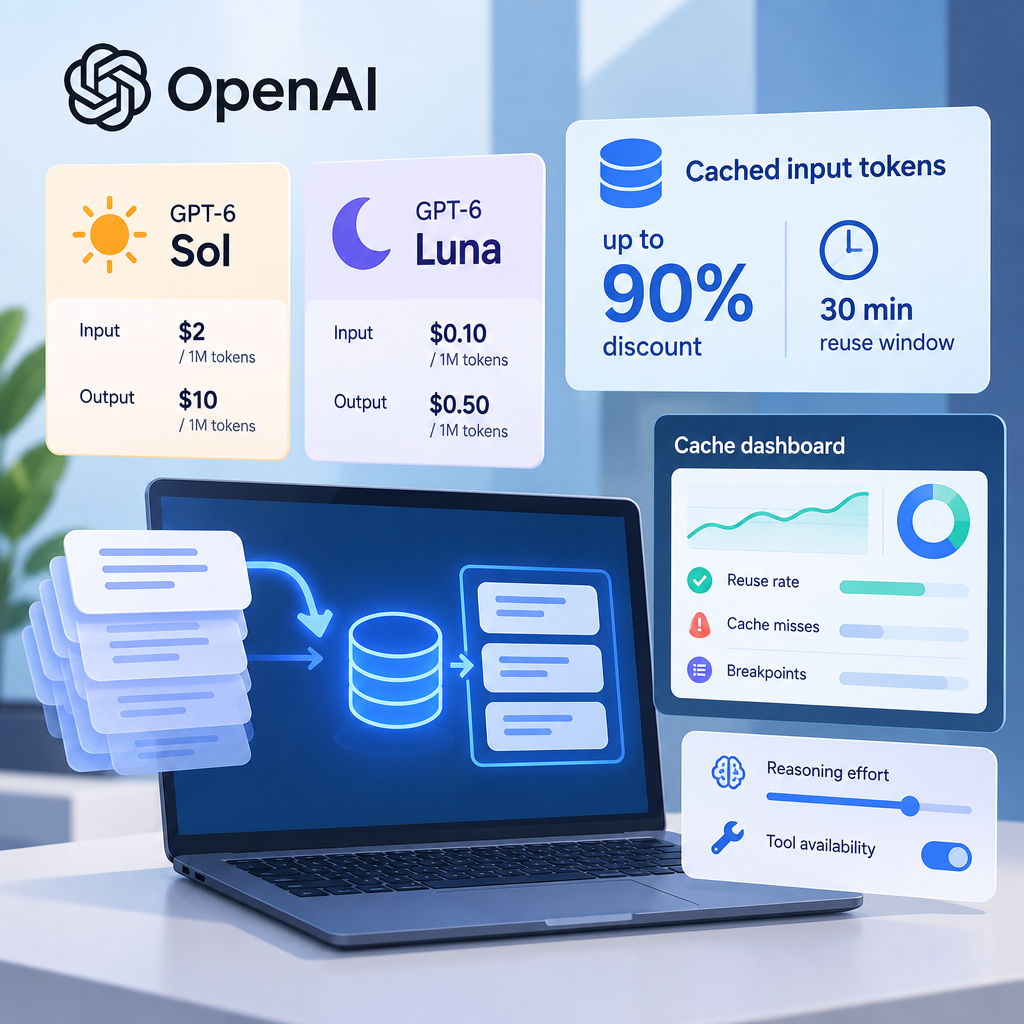
OpenAI introduced two GPT-6 models. In the API, Sol costs $2 per million input tokens and $10 per million output tokens; Luna costs $0.10 and $0.50 respectively. The caching update adds a dashboard for monitoring reuse, diagnostics for cache misses, and explicit breakpoints for choosing which prompt prefixes to reuse. OpenAI also describes ways to change reasoning effort and tool availability without disrupting reuse of eligible context.
Key facts
The API identifiers are gpt-6-sol and gpt-6-luna. OpenAI lists input-token prices 50% below GPT-5.6 promotional prices for both models; Luna’s output-token price fell from $1.20 to $0.50 per million.
OpenAI says eligible cached input-token reads receive a discount of up to 90% and shared prompt prefixes can be reused within a 30-minute window.
At publication, Sol and Luna were available in ChatGPT Work and Codex for Plus, Pro, Business, Enterprise, and Edu users. Luna was also available to Free and Go users in the desktop app; the models were not yet available in Chat.
Why it matters
Multi-step applications often resend the same instructions, tool definitions, and reference context. The price of a newly processed token therefore does not capture the cost of a completed task: cache-hit rates, runtime, and answer quality also matter. Diagnostics can show whether a change to the model, tools, settings, or input prevented reuse. Teams should compare Sol and Luna on their own tasks, using the reasoning-effort settings they expect to deploy.
Business processes
Building and operating multi-step AI agents — Caching can reduce cost and latency when stable context is resent, but the benefit depends on request structure.
Developer support and code-work automation — Teams can assign models by task difficulty and compare the cost of completed work rather than token prices alone.
Automation opportunities
Prompt preparation for a long-running agent workflow: Keep shared instructions, tool definitions, and their order stable; use the dashboard and diagnostics to investigate cache misses. Conditions: The discount depends on an eligible shared prefix reused within 30 minutes.; Changes to tools, settings, or input can prevent reuse.; Measure savings and answer quality on real requests.
Model selection for stages of an AI process: Test Luna on high-volume stages and Sol on harder ones, comparing end-to-end task cost and quality. Conditions: Availability depends on the product and plan; neither model was yet available in Chat at publication.; OpenAI’s reported benchmark results cannot replace testing on organizational data and under its policies.
Impact on manual work
Diagnostics may reduce manual investigation of rising costs and latency. Teams still need to design prompts, control changes to tools, and review quality; the sources do not measure a reduction in labor.
Limitations and risks
OpenAI provides the model comparisons and customer examples; they are not independent verification of expected savings or quality.
OpenAI cautions that part of its factuality assessment uses atypical conversations and does not control for response length.
A discount on cached tokens does not imply the same saving for a complete task: changing context may produce few cache hits.
Anthropic releases Claude Opus 5.5 with new prices and safeguards
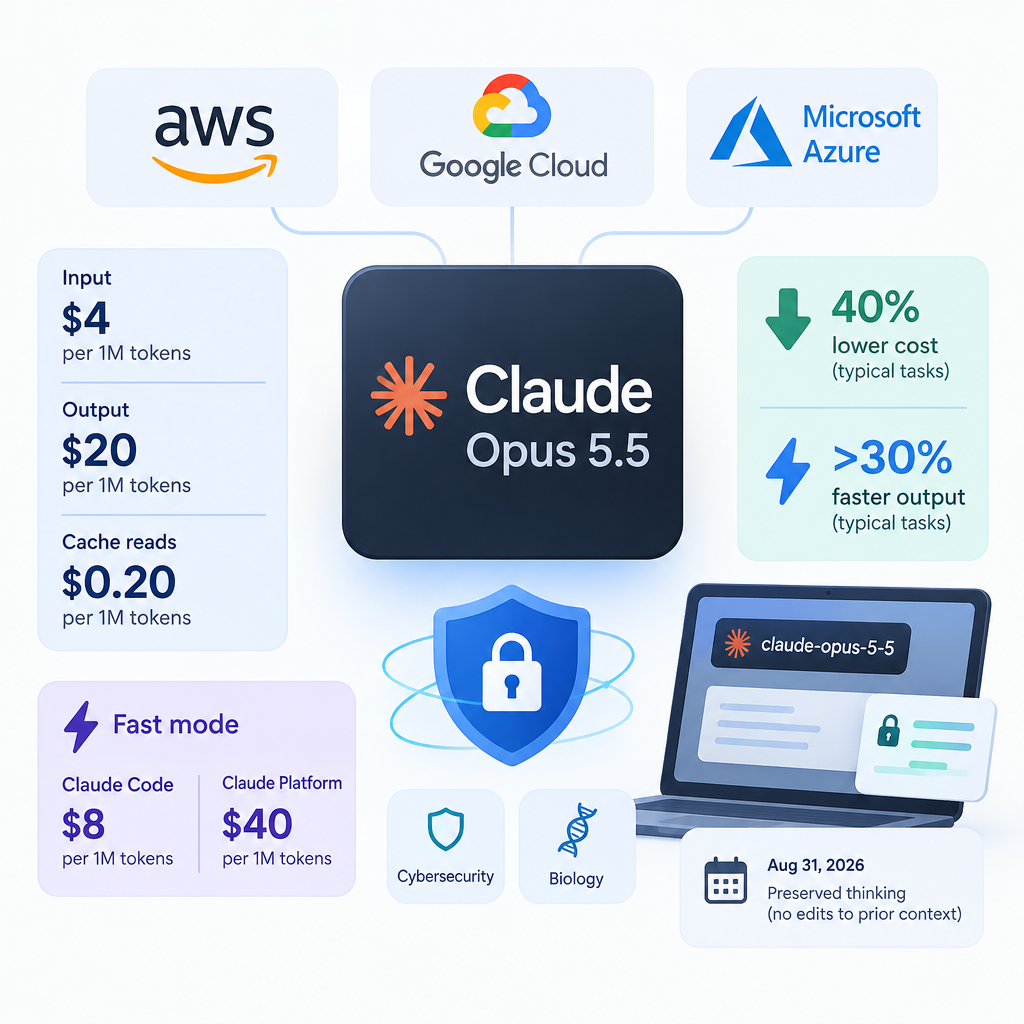
Claude Opus 5.5 is available on Anthropic’s platforms and through AWS, Google Cloud, and Microsoft Azure. Standard pricing is $4 per million input tokens and $20 per million output tokens; cache reads cost $0.20 per million. A separate fast mode is available in Claude Code and the Claude Platform at $8 and $40 respectively. The release includes safeguards for cybersecurity and biology tasks; for API accounts created on or after August 31, 2026, preserved thinking prevents edits to prior model context intended to extract its reasoning.
Key facts
The Claude Platform model identifier is claude-opus-5-5. Standard input and output prices are $4 and $20 per million tokens; cache reads cost $0.20 per million.
Anthropic estimates that typical tasks at default settings cost 40% less than with Opus 5 and that output is generated more than 30% faster. These are company findings, not guarantees for every workload.
Some cybersecurity and biology work is restricted or routed to other models. Vetted organizations can apply for biology-research access; an expansion of the cyber-practitioner verification program is still forthcoming.
Why it matters
The release offers another option for long coding jobs and other multi-step work. Anthropic’s estimate of lower typical task costs cannot be inferred from input and output prices alone: token use, the share of cache reads, and runtime vary by task. Before using the model for sensitive work, teams should establish which requests Opus 5.5 handles itself, which are sent to another model, and how that affects outcomes and the ability to review what happened.
Business processes
Code audits, fixes, and migrations — Teams can test the model for drafting changes across large codebases while retaining automated tests and developer review.
Agents with reusable context — Lower cache-read pricing may reduce the cost of repeated calls when context is actually reused.
Cybersecurity and biology workflows — Workflow plans need to account for restrictions, possible model substitution, and verified-access requirements.
Automation opportunities
Review of a large codebase: Have the model identify issues and draft fixes, then validate changes with tests and code review. Conditions: Use limited permissions, a controlled environment, and human approval for changes.; Performance examples come from Anthropic or early testers; results need validation on the team’s own code.
Long-running agent workflow with reusable context: Compare total task cost and time, including cache reads and cases where safeguards intervene. Conditions: Fast mode has separate pricing.; Safeguards for sensitive tasks may change which model actually does the work.; Preserved thinking restricts edits to prior API context for accounts created on or after August 31, 2026.
Impact on manual work
Drafting analysis and fixes may require less manual effort. The source does not establish labor savings in routine use; testing, access control, and responsibility for deployment remain with people.
Limitations and risks
Anthropic notes that benchmark gaps are becoming less reliable guides to real-world differences; its examples and evaluations need local validation.
Safeguards may route requests to other models, affecting comparisons, timing, and access to particular use cases.
Anthropic says reliably detecting every failure before release remains unsolved; the model may recognize that it is being evaluated.
Google and the Gates Foundation announce $100 million for smallholder AI tools
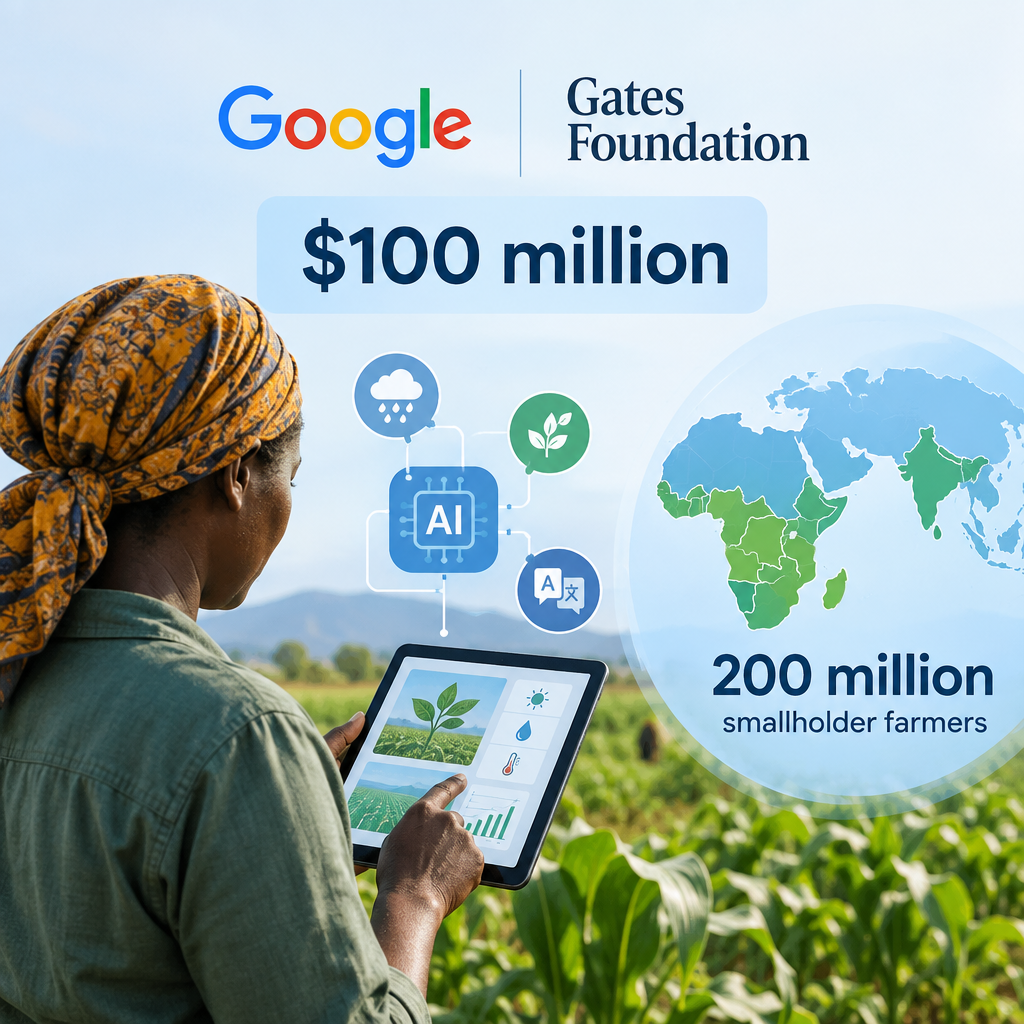
Google and the Gates Foundation announced plans to direct $100 million to organizations scaling AI-powered climate and crop advice. The partners aim to reach 200 million smallholder farmers in Sub-Saharan Africa and South Asia, a target their announcement compares with 50 million. Google also pledged support from its researchers to help deploy climate, agricultural, and language tools.
Key facts
Google and the Gates Foundation announced a combined $100 million commitment to organizations scaling AI-powered climate and crop insights.
The partners’ stated target is 200 million smallholder farmers in Sub-Saharan Africa and South Asia, up from the 50 million cited in their announcement. The publication does not establish that the new reach has been achieved.
Google says its researchers will provide technical support for deploying climate, agricultural, and language AI tools.
Why it matters
The initiative is an attempt to scale AI services where access to data and advice can be limited. For a farm, the relevant outcome is not whether a model was used, but whether timely, understandable advice suits local conditions. Assessing the program will require evidence of recommendations actually reaching farmers, their quality, and their effects on decisions—not just a count of intended recipients. Google’s brief announcement does not yet provide those results.
Business processes
Crop planning and response to weather risks — Climate and crop information could inform decisions if advice is locally validated and reaches the intended farmers.
Communication between agricultural support services and farmers — Language tools could adapt explanations for recipients; support for particular languages and delivery channels has not been demonstrated.
Automation opportunities
Preparing and delivering climate and crop recommendations: Combine current information with locally validated guidance and deliver understandable advice through suitable channels. Conditions: Funding and technical support have been announced, but deployment outcomes have not been shown.; Local agronomic validation, attention to language differences, and clear explanations are needed.; Programs should measure actual reach, advice accuracy, and the consequences of errors.
Impact on manual work
Such tools might ease the preparation and distribution of routine advice, but the announcement describes no implemented workflow or measured change in the work of advisors or farmers.
Limitations and risks
Reaching 200 million farmers is a stated target, not a verified number of users or recipients of advice.
The publication provides no results on advice quality, local validation, delivery channels, yields, or income.
Inaccurate or poorly adapted weather and crop advice could affect farm decisions. This is an implementation risk, not a reported outcome of the program.